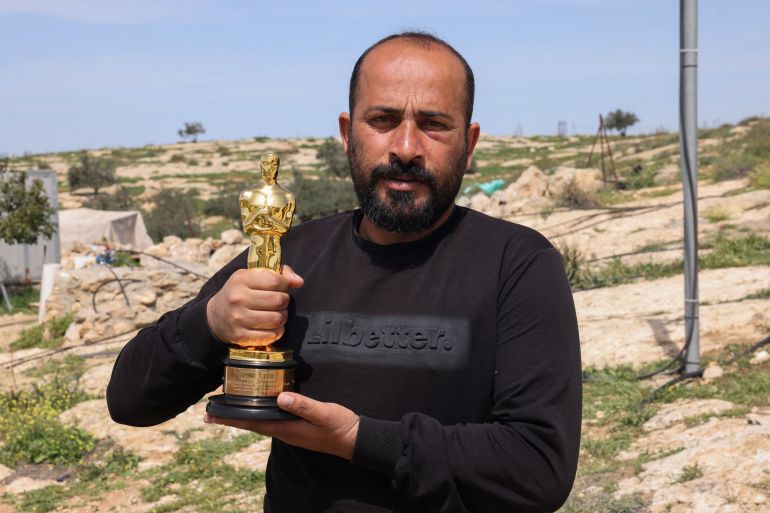
One year on, No Other Land co-director says Israeli attacks intensifying
Oscar-winning director Hamdan Ballal says his family was attacked despite an Israeli court ruling in their favour.

By Federica MarsiPublished On 16 Feb 202616 Feb 2026
Save
Nearly a year since the Palestinian-Israeli film No Other Land won an Academy Award, its co-director, Hamdan Ballal, says Israeli settler attacks on the cluster of occupied West Bank villages known as Masafer Yatta have only gotten worse, as those involved in the documentary bear the brunt of Israeli reprisals.
The latest bout of violence came on Sunday, when Israeli settlers stormed Ballal’s hometown of Susya, despite an Israeli court ruling designating the area around his home as closed to non-residents. Israeli army officers called by the family to enforce the ruling, issued two weeks prior, sided with the attackers.
Recommended Stories
list of 3 itemsend of list
“The ruling was supposed to make things better for us, but the opposite happened,” Ballal told Al Jazeera on Monday. “Israeli authorities did nothing to enforce the decision, but joined the settlers in the attack.”
One of his brothers was held in a chokehold by an army officer and later hospitalised with breathing difficulties. Four other relatives – two brothers, a nephew, and a cousin – were detained for several hours as they arrived at the scene. They have all since been released.
The Palestinian film director said his family was ambushed by the same Israeli settler who led an attack against him as he returned from the Oscar ceremony in Los Angeles last March. Then, he had been taken away in a blindfold by a group of Israeli settlers and army officers and released a day later with injuries to his head and stomach, leading to global condemnation.
Ballal said the retaliation for the documentary has since been directed against his family, rather than himself, to avoid media attention. His relatives have been routinely prevented from grazing sheep and ploughing the land. At times, they have been arrested, questioned about his work and whereabouts, or intimidated to vacate their homes.
Advertisement
“My family is paying because of me; because I shared the movie and I shared the truth,” he said.
The film, which won the Oscar for best documentary on March 2, follows Palestinian journalist Basel Adra and Israeli journalist Yuval Abraham as they try to protect Palestinian homes amid tensions with settlers in Masafer Yatta in the South Hebron Hills. Israeli filmmaker Rachel Szor also shares directing credits.
Israeli settlers in the area often graze their animals on Palestinian land to assert control, signal unrestricted access, and lay the groundwork for establishing illegal outposts, cutting Palestinians off from their farms and livestock.
The Israeli army argues that it has to demolish the Palestinian villages to convert the area into a military “firing” or training zone. It did not respond to Al Jazeera’s request for comment on Sunday’s incident.
Across the occupied West Bank, Israel’s far-right coalition government, led by Prime Minister Benjamin Netanyahu, has been openly promoting new measures to expand Israeli control over the Palestinian territory.
Most recently, it announced the resumption of the land registration processes for the first time since 1967, which Israeli rights groups say will accelerate the dispossession and displacement of Palestinians in violation of international law.
‘Right to live’
Ballal’s family has not been the only one to pay the price for the acclaimed documentary.
Adra, the Palestinian protagonist in the film, had his home in at-Tawani raided by the Israeli army in September, after clashes broke out with a group of Israeli settlers that trespassed in his olive grove.
In July, Awdah Hathaleen, an activist, football player and a consultant for No Other Land, was shot dead, in the chest, in the village of Umm al-Khair. The father of three was a key figure in non-violent resistance against settler violence in Masafer Yatta. His assailant, Israeli settler Yinon Levi, later said, “I’m glad I did it,” according to witnesses.
Ballal said he does not hesitate to describe these attacks as being “terrorist”, as they leave the Palestinian community in Masafer Yatta constantly fearing for their safety.
“It’s a simple right for Palestinians to feel safe in their homes,” he told Al Jazeera. “We are scared; we are in danger, and it’s been like this for a long time.”
“International law doesn’t work for Palestinians,” he continued. “But we are human, and we have a right to live.”