The USS Honduras sets sail again
With Nasry Asfura’s election and Trump’s backing, Honduras risks returning to its historical role as a US military, political and economic outpost used to project power across Central America.


Al Jazeera columnist.
Published On 11 Feb 202611 Feb 2026
Save
It’s smooth sailing these days for the United States and Honduras, the diminutive Central American nation and original “banana republic” that has just elected a new right-wing president, Nasry Asfura, to the delight of US sociopath-in-chief Donald Trump.
The gringo leader has even taken credit for Asfura’s victory, having threatened to cut off US aid to Honduras in the event that the electoral outcome was not to his liking.
Call it democracy at its finest.
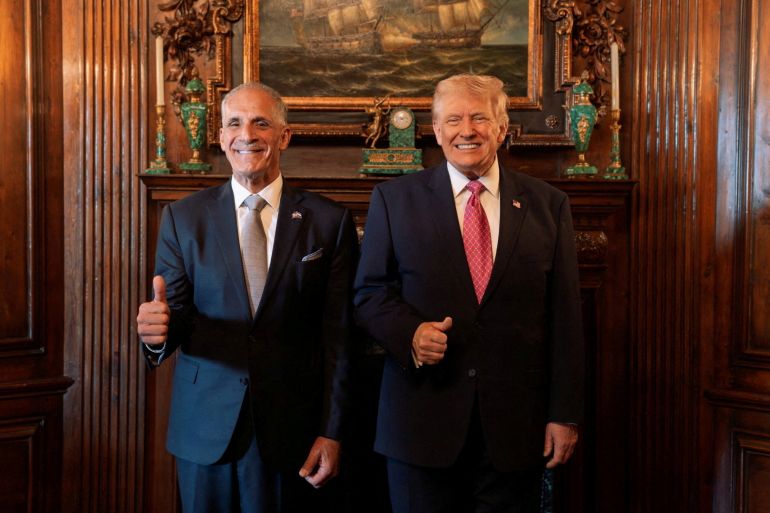
This past weekend, Trump hosted his “friend” and fellow businessman Asfura at his Mar-a-Lago resort in Florida, where the two committed to jointly combatting drug trafficking and irregular migration.
The pact might have been a tad less hypocritical had Trump not just pardoned former right-wing Honduran President and Asfura ally Juan Orlando Hernandez, who was serving a 45-year prison sentence in the US for – what else? – drug trafficking.
Then, of course, there is the fact that the US has played an outsize role in creating the violent conditions that cause mass migration from Honduras in the first place. But surely it’s nothing that can’t be solved by more business as usual.
Indeed, it seems the winds are just right for the resurgence of the “USS Honduras” – the endearing nickname that was bestowed on the country in the 1980s on account of its outstanding service as an imperial military base from which to terrorise neighbouring Nicaragua, which had committed the outrageous offence of telling the gringos to take their capitalist system and shove it.
Advertisement
Some 50,000 Nicaraguans perished in the US-backed Contra war, while CIA mercenaries aided the war effort by raking in profits from the drug trade, speaking of the US track record on that front.
Nor was life on board the USS Honduras anything to write home about. Throughout the 1980s, a CIA-trained death squad by the name of Battalion 316 made life hell for hundreds of Honduran citizens who were suspected of improper political orientation and were kidnapped, tortured, and killed.
And the US was calling the shots for just about everything. Writing in The New York Times in 1988, journalist Stephen Kinzer offered the lowdown on imperial machinations in Honduras with a straightforwardness uncharacteristic of the US newspaper of record: “Behind the guise of formal democracy [in Honduras], military leaders make all important decisions, and they respond to direction from the United States Embassy.”
This embassy, Kinzer noted, was “one of the largest State Department outposts in the world”, adding that “American diplomats exercise more control over domestic politics in Honduras than in any other country in the hemisphere.”
And yet there were rough waters ahead for the USS Honduras – particularly with the 2006 election of ever-so-slightly-left-leaning President Manuel Zelaya, who had the nerve to raise the urban minimum wage to $290 a month and otherwise stab international corporations in the back.
The metaphorical naval vessel having been thus definitively blown off course, there was no choice but for the Honduran military to – very democratically – kidnap Zelaya in the wee hours of June 28, 2009, and whisk him off to Costa Rica in his pyjamas, never to be reinstated to his elected post.
The US-validated coup d’etat ushered in an era of intensified impunity in Honduras, as the domestic forces of law and order responded sadistically to unarmed anti-coup protesters, femicides skyrocketed, and the small nation embarked on its path to becoming the murder capital of the world.
In other words, all was dandy from a capitalist point of view, and, once illegitimate elections had been staged by the Honduran coup regime, the Democratic regime of then-US President Barack Obama wasted no time in signing off on the electoral triumph of the right-wing Porfirio Lobo, who quickly declared Honduras “Open for Business.”
Things then got even better with the reign of the aforementioned narco-President Juan Orlando Hernandez, whose re-election in 2017 amid ubiquitous fraud allegations was swiftly recognised by the first Trump administration – and never mind the ensuing slaughter, by US-funded security forces, of Hondurans protesting the election results.
Advertisement
Now that Trump is back at the helm of the USS Honduras with Asfura as first mate, it would have been remiss had Israeli Prime Minister Benjamin Netanyahu not turned up on deck, as well.
During a January visit to Jerusalem to kiss Israel’s genocidal backside, Asfura made a downright disgusting mockery of his own Palestinian origins, responding with enthusiasm to Netanyahu’s declaration that he looked “forward to working with your government, both in economic fields and agriculture and technology in any of the areas that I think are laid before us”.
The man with the blood of potentially many hundreds of thousands of Palestinians on his hands proceeded to reassure the Palestinian-descended Honduran head of state, “You should know that as far as Israel is concerned, the sky is the limit.”
Under Asfura, Honduras is, no doubt, on course to renew its status as a key node of US power and influence in the hemisphere, giving Trump even greater leeway to wreak havoc in Venezuela, Cuba, and wherever else he sees fit – and probably guaranteeing a lot more spectacular violence to come in Honduras itself.
And as the USS Honduras sets off with vigour on its latest voyage of imperial servitude, you might say the sea is the limit, too.
The views expressed in this article are the author’s own and do not necessarily reflect Al Jazeera’s editorial stance.