Thailand’s Bhumjaithai set for coalition talks after surprise election win
Conservative party looks set to win at least 194 seats in Thailand’s 500 member House, Thai media say.


Published On 9 Feb 20269 Feb 2026
Save
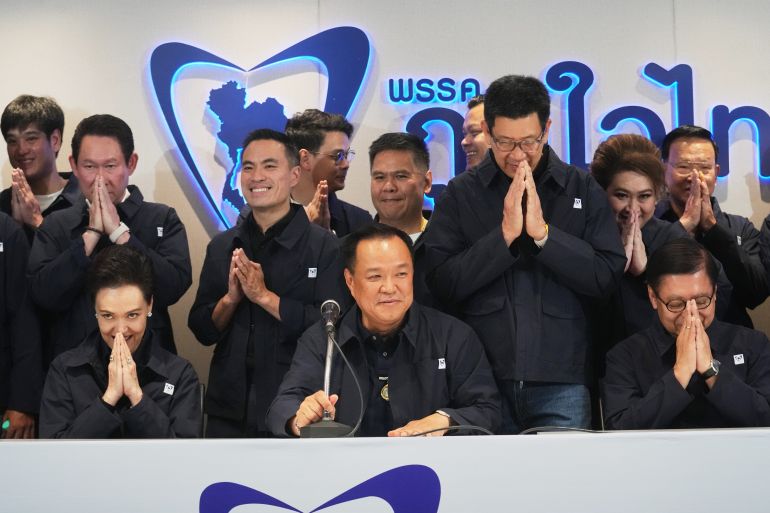
Thailand’s Bhumjaithai Party has secured a stronger-than-expected victory in Sunday’s general election, with Prime Minister Anutin Charnvirakul claiming victory and preparing for a coalition in the coming days.
With 93 percent of ballots counted on Monday, the conservative Bhumjaithai was far ahead of its rivals, looking set to win at least 194 of the 500 seats in Thailand’s parliament, according to Thai media.
Recommended Stories
list of 4 itemsend of list
The progressive People’s Party, which led some polls in the run-up to the vote, came in second with an estimated 116 seats.
The Pheu Thai party of jailed former Prime Minister Thaksin Shinawatra came in third, with 76 seats.
Speaking to reporters on Sunday, as Bhumjaithai’s strong lead became clear, Anutin said that Thai voters have given his party “more than we expected”.
“So we owe our voters a fortune. We will only repay them by working at our utmost to bring all the good things to them, to our country,” he said.
Asked about forming a coalition and appointing a cabinet, Anutin said he was waiting for clarity on the final numbers, and that each party would need to hold internal discussions on how to proceed.
Anutin called the election in December after fewer than 100 days in office, seeking to capitalise on a wave of nationalism generated by Thailand’s three-week conflict with Cambodia.
He described the election result as “a victory for all Thais”.
The People’s Party has already ruled out the possibility of joining a coalition led by Anutin, with its leader, Natthaphong Ruengpanyawut, saying late on Sunday that it would not seek to form a rival coalition.
Advertisement
Polls at the end of January suggested the People’s Party was significantly ahead of Bhumjaithai.
Al Jazeera’s Tony Cheng, reporting from Bangkok, called the outcome of Sunday’s election “somewhat of a surprise”.
“But the two things we kept hearing from Thai voters, regardless of political affiliation, was that people wanted stability to return to Thai politics. This was an election that shouldn’t have happened. The last one only happened three years ago. So it was a sign Thailand was teetering on the edge,” Cheng said.
“The other thing Thai voters wanted was economic growth. This is a country that’s been in economic stagnation for nearly two decades now, while it’s surrounded by countries seeing huge growth: Indonesia, the Philippines, Vietnam – all growing between 5 and 6 percent. Thailand is barely scraping along at 1.5 percent GDP growth. And it’s falling back. And the voters wanted to arrest that halt and to give it a significant boost,” he added.
Bhumjaithai will now look to smaller parties to form a coalition.
Possible partners include Deputy Prime Minister Thammanat Prompao’s party, Kla Tham, which looks set to win an estimated 58 seats, according to Thai media.
Together, Bhumjaithai and Kla Tham could surpass the 251 votes required to form a government.
The prime minister previously indicated that if he was re-elected, the incumbent ministers of finance, foreign affairs and commerce would retain their roles in a new cabinet.
“Bhumjaithai will start negotiations to form a coalition government in a position of great strength. They won’t need to give away important ministries to smaller parties. They will be able to bring in a couple of partners, but they’ll very much be in the driving seat,” said Al Jazeera’s Cheng.
“With this return to power, Anutin has got a popular mandate, his party will be firmly back in parliament, they’ll be able to pass the bills he needs, and I think, again, that’s what Thai voters wanted,” he said.
“They voted for stability and economic growth.”
Thai voters on Sunday also backed a proposal to change the constitution, with nearly two-thirds in favour of replacing a charter put in place after a 2014 military coup, which critics say gave too much power to an undemocratic Senate.
It is expected to take at least two years to implement the new constitution, with two more referendums required to endorse the drafting process and the final text.