Global system of human rights in ‘peril’, warns HRW in its annual report
The NGO warns that the rules-based order is being crushed under relentless pressure from the US, China and Russia.

Published On 4 Feb 20264 Feb 2026
Save
Human Rights Watch (HRW) has released its annual World Report 2026, warning that the global system of human rights is in “peril”, with 72 percent of the world’s population now living under “autocracy”.
In the report (PDF) published on Wednesday, the rights body warned that the United States, China and Russia are “led by leaders who share open disdain for norms”, and “wield considerable economic, military, and diplomatic power”.
Recommended Stories
list of 3 itemsend of list
“Under relentless pressure from US President Donald Trump, and persistently undermined by China and Russia, the rules-based international order is being crushed, threatening to take with it the architecture human rights defenders have come to rely on to advance norms and protect freedoms,” Philippe Bolopion, executive director at HRW, said in a statement.
“To defy this trend, governments that still value human rights, alongside social movements, civil society, and international institutions, need to form a strategic alliance to push back.”
Below are the highlights of the report that paint a bleak picture of the global human rights situation.
United States
The HRW report accuses the Trump administration of a “broad assault on key pillars of US democracy and the global rules-based order”.
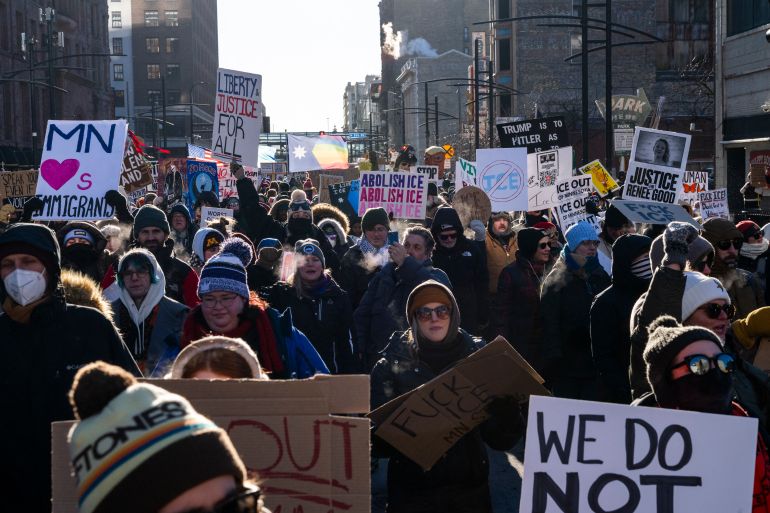
“Immigrants and asylum seekers have been subjected to inhumane conditions and degrading treatment; 32 died in US Immigration and Customs Enforcement custody in 2025”, and another four in January 2026, it said.
The “unlawful” abduction of Venezuelan President Nicolas Maduro, along with its withdrawal from the United Nations Human Rights Council and the World Health Organization and its sanctions on Palestinian human rights organisations, the prosecutor of the International Criminal Court and ICC judges, as well as a UN special rapporteur, were highlighted in the report.
Advertisement
“Trump’s second administration has been marked from the start by blatant disregard for human rights and egregious violations,” the report said, adding that the US government is seeking “to weaken international institutions created to enforce human rights standards and hold violators to account”.
Israel
“The Israeli armed forces have committed acts of genocide, ethnic cleansing, and crimes against humanity,” the report said, adding that “These crimes were met with uneven global condemnation and not nearly enough action.”
Trump’s plans for Gaza “would be tantamount to ethnic cleansing”, HRW said, while Israel’s killing of Palestinians in Gaza and its demolitions and unlawful restrictions in the occupied West Bank continue.
The report comes days after the Israel-Palestine director of HRW quit after the rights body “blocked” a report on Israeli atrocities against Palestinians. Omar Shakir, who has worked for the rights group for more than 10 years, told Al Jazeera he has lost faith in the organisation after its new chief, Bolopion, blocked a report accusing Israel of committing “crimes against humanity” in its denial of Palestinian refugees’ right of return.
Shakir said on Tuesday that the report “sought to connect the erasure of camps in Gaza with the emptying of camps in the West Bank, with the full assault led by the Israeli government against UNRWA, the aid agency for Palestinian refugees and underscoring how in the midst of this Nakba 2.0 that we’re seeing unfold beyond us, it’s critical that we learn the lessons from Nakba 1.0”.
The Nakba, which means catastrophe, refers to the forced displacement of 750,000 Palestinians expelled from their homes and land by Zionist militias leading up to the establishment of the State of Israel in 1948.
Ukraine
In Ukraine, Russia’s “indiscriminate bombing, coercing Ukrainians in occupied areas to serve in the Russian military, systematic torture of Ukrainian prisoners of war, the abduction and deportation of Ukrainian children to Russia, and the use of quadcopter drones to hunt and kill civilians” have not been met with meaningful pressure.
Russia
Russia’s intensifying crackdown on dissent and civil society includes authorities using ill-treatment of those in custody as a “tool of repression” and wielding legislation to target “foreign agents” and “undesirable” organisations.
The head of the election monitoring group Golos, Grigory Melkonyants, was sentenced to five years in prison. Three lawyers were sentenced to prison terms for providing legal services to the Anti-Corruption Foundation’s founder, Alexey Navalny, who died in prison in 2024.
Advertisement
“Authorities throughout the country continued to prosecute people for commemorating Navalny’s memory, sharing information about him, using his name, or displaying his portrait,” the report said.
The foundation was also designated a “terrorist organization” by the country’s Supreme Court. International rights groups, including HRW, Amnesty International, Reporters Without Borders and the International Federation for Human Rights, have also been banned in Russia.
China
In China, authorities “systematically deny the rights to freedom of expression, association, assembly, and religion, and persecute government critics”, the report says.
With the state controlling all significant channels of information and some of the world’s “most stringent surveillance and censorship”, critics face imprisonment and forced disappearance. Human rights defenders are frequently harassed and tortured, while those who belong to “illegal” religious groups are harassed and detained by police.
As Tibetans and Uighurs are forced to assimilate, the government released draft legislation, Promoting Ethnic Unity and Progress, which “seeks to justify existing repression of minorities and facilitate intensifying ideological controls both at home and abroad”.
Filling the vacuum
The report stresses there is an “urgent need for a new global alliance to support human rights”.
HRW said it is “critical to look beyond the usual suspects”, pointing to countries such as Costa Rica, Ghana, Malaysia, Mexico, Senegal, Sierra Leone, and Vanuatu, which have “played important roles on specific human rights initiatives in key international forums”.
Chile’s Democracy Forever summit brought together leaders from Brazil, Colombia, Spain and Uruguay, who pledged to engage in “active democratic diplomacy”, while The Hague Group was formed in solidarity with Palestinians and in defence of international law.
Student protests in support of Palestine, protests against ICE abuses in the US and Gen Z protests in Nepal, Indonesia and Morocco were cited as examples of enduring people power.