Will killings by immigration agents cause another US government shutdown?
The death of Alex Pretti has prompted a shift among Democratic senators, who are willing to risk a shutdown for reforms.

 By Joseph StepanskyPublished On 29 Jan 202629 Jan 2026
Save
The United States could be careening towards another government shutdown, in which federal agencies are forced to close because Congress cannot pass legislation to fund them.
That was not always the case. At first, it seemed like Friday’s deadline to pass a new spending package would pass without much fuss.
Recommended Stories
list of 3 itemsend of list
But an impasse has emerged in the waning days before the deadline. The shift came amid public outrage at the latest shooting death resulting from US President Donald Trump’s immigration enforcement drive.
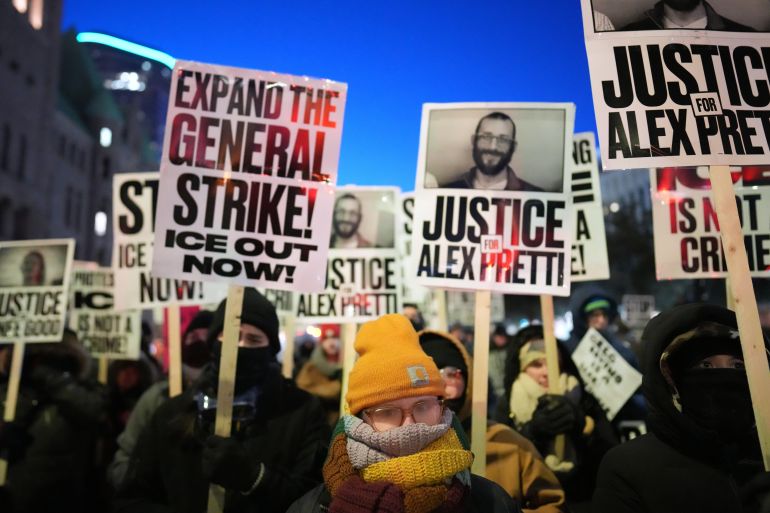
In the days since immigration agents killed US citizen Alex Pretti in Minneapolis, Minnesota, on Saturday, Democrats have drawn a stark line.
They have pledged to approve no funding increases for the Department of Homeland Security (DHS), which oversees the agencies spearheading Trump’s deportation drive, unless it agrees to place guardrails on its use of force.
An initial vote on Thursday saw every Democrat and, surprisingly, a handful of Democrats vote against a funding package.
That came shortly after Tom Homan, the US border security chief, said immigration agents would shift their approach in Minnesota but vowed to maintain a continued presence in the state.
Lawmakers in the Senate now have until midnight on Friday (05:00 GMT on Saturday) to find a solution. Here’s how we got here and what comes next:
What’s in the legislation?
Republicans will need to reach a 60-vote threshold in the 100-seat Senate to pass the funding legislation. They currently control 53 seats, meaning they will need both party unity and the support of at least seven members of the Democratic caucus to pass funding.
Advertisement
All told, the legislation includes six separate bills to fund the Department of Defense, the Department of Labor, the Department of Health and Human Services, the Department of Education, the Department of Transportation, the Department of Housing and Urban Development, the Department of the Treasury, and, most notably, DHS.
The bills are all linked in a sprawling $1.2 trillion package passed by the US House of Representatives last week. Without the funding, non-essential services in those departments would grind to a halt.
Why not vote separately on DHS funding?
Any changes to the House-approved package — including voting separately on DHS funding — would require overcoming lengthy procedural hurdles in the Senate.
Then, the legislation would have to return to the House of Representatives for a new vote.
The House is currently in the middle of a weeklong recess, and House Speaker Mike Johnson, a Republican, is unlikely to call his chamber’s representatives back to Washington for a second vote.
Thursday’s initial 45-55 vote in the Senate scuttles the prospect of the wholesale package being quickly approved, raising the possibility over the funding bills being broken up to separate the controversial DHS funding.
How much funding is there for DHS?
Compared with last year, the new spending package would add $400m more to the detention budget for Immigration and Customs Enforcement (ICE) and $370m more for its enforcement budget.
That is on top of a $170bn windfall for DHS included in last year’s sprawling tax-and-spending law, known as the “One Big Beautiful Bill Act.” It earmarked about $75bn for ICE over the next four years.
Why is the funding controversial?
Rights advocates have condemned the current funding bill for providing yet more funding to ICE, the agency at the heart of Trump’s deportation drive.
Just this month, US immigration officers have been connected to two high-profile shooting deaths in Minneapolis: Pretti’s killing on Saturday by two US Border Patrol agents, and the shooting of Renee Nicole Good by an ICE agent on January 7. Both shooting victims were US citizens.
Last week, a handful of House Democrats broke with their party to vote for the spending package. At the time, seven Democrats backed the funding legislation, while 206 opposed it.
The vote was ultimately 220 to 207, with Republican Thomas Massie joining the majority of the Democrats in opposition.
This latest budget fight comes less than three months after a record-breaking, 43-day-long government shutdown came to a close on November 12, 2025. Polls show such disruptions are widely unpopular across the political spectrum.
Advertisement
What were the expectations leading up to this week?
In the run-up to Friday’s shutdown deadline, Democrats in the Senate were bracing for a similar fracture among their party members.
Several had been expected to hold their noses and vote to support the spending bill, in part fearing the political optics of another government shutdown.
On January 20, Democratic Senator Patty Murray argued against shutting down the government yet again, calling it an ineffective tactic to curb ICE.
“ICE must be reined in, and unfortunately, neither a [continuing resolution] nor a shutdown would do anything to restrain it, because, thanks to Republicans, ICE is now sitting on a massive slush fund it can tap whether or not we pass a funding bill,” she wrote in a statement.
Murray called on her party to instead focus its efforts on winning the upcoming midterm elections. “The hard truth is that Democrats must win political power to enact the kind of accountability we need,” she said.
Why has Democratic sentiment changed?
Pretti’s killing on Saturday changed the dynamic for Democrats.
His shooting by US Border Patrol agents was followed by a swarm of baseless claims from the Trump administration, accusing Pretti — a nurse who treated US veterans — of being a “domestic terrorist”. That, in turn, fuelled further outrage at his death.
Senator Murray was among those who shifted her stance in the wake of the killing. Her response was unequivocal.
“I will NOT support the DHS bill as it stands,” she wrote in a post on the social media platform X. “Federal agents cannot murder people in broad daylight and face zero consequences.”
Chuck Schumer, the top Democrat in the Senate, also abandoned earlier assurances that a shutdown would be avoided.
Left-wing senators Catherine Cortez Masto, Jacky Rosen and Angus King have also announced they will not vote in favour of the funding bill as is, despite having broken from party ranks to end the last shutdown in November.
In a post on Wednesday on X, Schumer showed little sign of yielding.
“In the wake of ICE’s abuses and the administration’s recklessness, Senate Democrats will NOT pass the DHS budget until it is rewritten,” he wrote.
Will the party remain united?
To date, the party has yet to present a list of demands on changes to the DHS funding.
Reforms floated by Democrats include requiring judicial warrants for immigration arrests, doing away with the Trump administration’s detention quotas, and mandating that federal agents unmask themselves and wear identification.
Other proposed measures involve prohibiting US Border Patrol agents from being deployed within the interior of the US and requiring that local and state authorities be involved in use-of-force investigations.
State officials in Minnesota have complained in recent weeks that they have been shut out of the federal investigations into the killings of Good and Pretti.
While Trump has distanced himself from his administration’s comments calling Pretti a “terrorist”, his more conciliatory tone has not extended to Democratic officials.
Advertisement
On Wednesday, he again blamed Democrats for escalating tensions in Minnesota and warned that Minneapolis Mayor Jacob Frey was “playing with fire” for failing to fall in line with his immigration policies.
Top Democrats, in turn, have dismissed any promises for reform not codified in law.
“If the government shuts down yet again, it will be because congressional Republicans refuse to place guardrails on this reckless president and the ICE agency,” Senator Dick Durbin said during a floor speech on Wednesday.
“In the meantime, I urge my colleagues to join us in that endeavour before [DHS Secretary] Kristi Noem and her squad take another innocent life.”