Militarising the Sahel will not defeat terrorism
US air strikes, rival military blocs and competing foreign backers are reshaping security in West Africa and pushing states closer to conflict.


Associate Lecturer in International Relations at Liverpool John Moores University.
Published On 23 Jan 202623 Jan 2026
Save
After launching what he called “a powerful and deadly strike against ISIS [ISIL] terrorist scum” in northwest Nigeria on December 25, United States President Donald Trump promised “many more”, reaffirming his stance that the US “will not allow radical Islamic terrorism to prosper”. The strikes occurred less than a week after the newly formed Alliance of Sahel States (AES) commissioned a joint military force comprising a 5,000-strong contingent, presented as a symbol of collective self-reliance and security autonomy, in a concerted effort to combat terrorist groups in its member states. They also followed moves by the Economic Community of West African States (ECOWAS) to establish an ambitious plan announced in August 2025 to activate a 260,000-strong joint counterterrorism force, backed by a proposed $2.5bn annual budget for logistics and front-line support.
While these developments may be presented by their proponents as decisive steps against terrorism, there is little evidence that militarised escalation alone can defeat armed groups in the Sahel. Instead, they signal an accelerating militarisation of the region. Not only does this fuel emerging geopolitical tensions in West Africa, but it also, more importantly, edges the Sahel towards interstate armed conflict, posing far graver risks to regional peace and stability.
A friendship turned sour
Until 2021, counterinsurgency and counterterrorism operations in the Sahel were governed by a loosely coordinated, non-hierarchical security architecture built around diplomatic and military collaboration among regional and extra-regional actors. This architecture brought together ECOWAS, the European Union, the United Nations, the African Union, external powers such as the US and France, as well as regional powers such as Algeria and Nigeria, with ECOWAS playing a central coordinating role.
Advertisement
A typical example was the 2013 African-led International Support Mission to Mali, organised by ECOWAS in collaboration with the AU, UN and France to confront Tuareg rebels and allied armed groups in northern Mali. More prominent was the EU-financed G5 Sahel counterterrorism force, which brought together African and European troops and operated between 2017 and 2023. While these arrangements were often marked by tension, competition and uneven outcomes, they functioned within a shared security framework that limited direct confrontation between states.
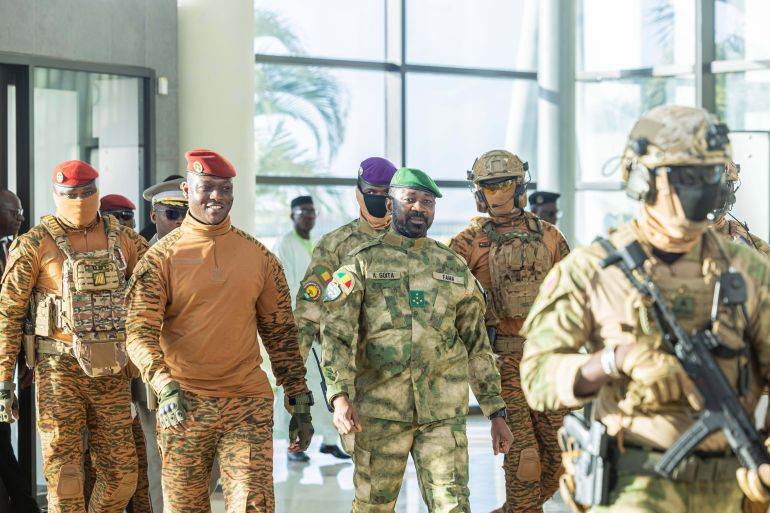
This balance was disrupted after the 2023 coup in Niger. By threatening the use of force to restore constitutional order, ECOWAS crossed a political threshold that transformed its role from intermediary to perceived adversary in the eyes of the Nigerien junta. That threat was widely interpreted as an act of aggression, and it proved catalytic. In response, Niger’s military rulers, alongside their counterparts in Mali and Burkina Faso, moved to establish the Alliance of Sahel States as a deliberate effort to reclaim security autonomy, dismantle the existing multilateral security regime and sever ties with longstanding partners including ECOWAS, the EU, the US and France.
Notably, the AES institutionalises a mutual defence pact that codifies this break with the previous multilateral security order by explicitly framing ECOWAS and its Western partners as threats to the sovereignty and national security of its member states. Beyond deepening the rift between former allies, this posture signals a dangerous shift towards the securitisation of neighbouring states, raising the spectre of interstate conflict in West Africa, a phenomenon largely absent since the 1990s.
Emerging geopolitical tensions
In severing security ties with the West, the AES have pivoted towards Russia as a principal security partner to counterbalance decades of US and European influence in West Africa, signalling a deepening but still evolving security partnership with Moscow. While these strategic choices reflect an emerging self-help posture with new preferences for non-conventional allies, they are also intensifying geopolitical tensions across the region.
Nigeria’s military role in countering an attempted coup in neighbouring Benin was praised as a major win for ECOWAS. But when a Nigerian Air Force C-130 aircraft made an emergency landing in Burkina Faso two days later, the AES interpreted this as a violation of its airspace and sovereignty, authorising its air force to neutralise any aircraft involved in further violations. Tensions were heightened by reports that France had provided Nigeria with surveillance and intelligence support during the Benin intervention, fuelling apprehension about France’s potential re-entry into the AES security landscape. With Nigeria now willing to extend security cooperation with the US following the Christmas Day strikes, the stakes have risen further for the AES. Although aimed at militants operating in northwest Nigeria, the strikes appear calculated to bolster US strategic legitimacy as a counterterrorism actor in the region, potentially opening the door to further operations in Nigeria’s northeast, where ISWAP and Boko Haram remain active.
Advertisement
Given Nigeria’s influence within ECOWAS, this emerging security partnership with the US is likely to shape the operational capacity of the proposed 260,000-strong ECOWAS force. This does not bode well for the AES, which is intent on insulating its member states from Western security influence in the name of sovereignty. Because ECOWAS forces would be deployed in member states at the epicentre of terrorist violence, many combat engagements would take place in locations adjacent to AES territories. With AES troops also operating in these areas, military clashes between the two sides become increasingly likely, particularly given the region’s porous borders and fluid combat environments. Given that the Christmas Day strikes reportedly hit unintended targets, the risk that future air strikes by a US-backed ECOWAS could spill into AES territory cannot be dismissed. For deterrence, the AES may seek to leverage Russia’s military backing, evoking echoes of Cold War-era security brinkmanship.
Implications for regional stability
Without reconciliation between the AES and ECOWAS, two major risks loom for regional peace and stability. First, rising geopolitical tensions could draw AES and ECOWAS member states into direct interstate military confrontations, potentially plunging West Africa into a regional war. Such a conflict would serve neither side’s counterterrorism objectives. Beyond devastating the region, it would create space for armed groups to expand their operations amid fractured and distracted security responses. Second, the standoff risks turning West Africa into a new theatre for global power rivalry, with a Russia-backed AES on one side and a US and France-backed ECOWAS on the other. In the context of an emerging New Cold War, the use of veto power by these global actors at the UN Security Council could further complicate conflict resolution, with profoundly destabilising consequences for the region.
The AES and ECOWAS now face a stark choice: to revive Cold War-style bloc politics in West Africa while the region slides towards chaos, or to negotiate a security sub-coalition that prioritises human security alongside national sovereignty. Regardless of how the AES views ECOWAS, the burden lies with the latter to manage the unintended consequences of escalating tensions. While there are few indications that the AES is willing to cooperate directly with a West-backed ECOWAS on counterterrorism, ECOWAS could pursue diplomatic engagement to negotiate a concept of operations that guarantees respect for AES sovereignty. As Africa’s most experienced regional security organisation, ECOWAS possesses the diplomatic capacity to do so. For progress to be made, Francophone ECOWAS member states should take the lead in these efforts, while Nigeria exercises its influence more discreetly. Whether ECOWAS can reclaim ownership of its security agenda and define the terms of external engagement will shape not only West Africa’s future, but that of the continent as a whole.
Advertisement
The views expressed in this article are the author’s own and do not necessarily reflect Al Jazeera’s editorial stance.