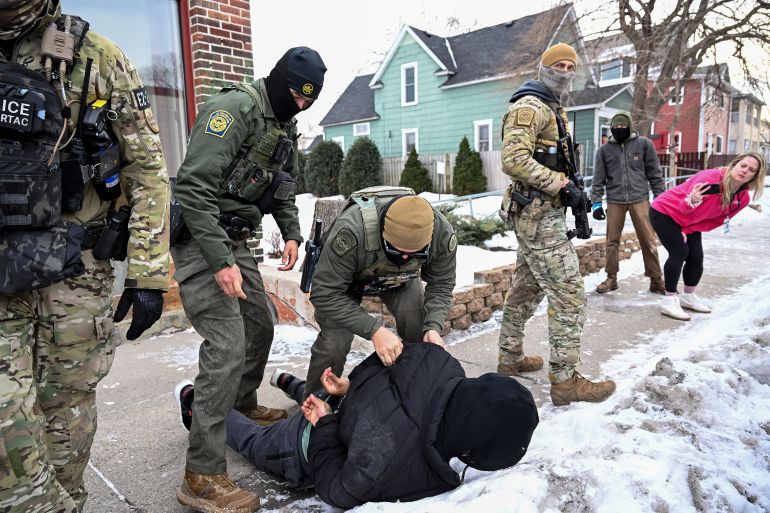
Are ICE agents trained to use ‘deadly force’ and evade lawsuits?
Investigative journalist Lila Hassan has uncovered evidence that shines a light into ICE’s controversial training, at a time when the agency faces scrutiny after Renee Nicole Good’s killing in Minneapolis.

 By Lila HassanPublished On 23 Jan 202623 Jan 2026
Save
In the weeks since United States Immigration and Customs Enforcement agent Jonathan Ross shot and killed Renee Nicole Good in Minneapolis, Minnesota, another ICE agent shot a Latino man in the leg, according to the Department of Homeland Security.
Good’s killing and the subsequent shooting have ignited a wave of calls and queries about whether ICE officers can be prosecuted. But the shootings in Minnesota are not outliers, and the history of ICE shootings shows that holding officers to account has been next to impossible.
I know, because I investigated the agency’s practices, obtaining documents that reveal how it operates and how its officers are trained to shield themselves from scrutiny and lawsuits. My 2024 investigation looked at six years of shootings informed by logs I obtained from the agency in a lawsuit. According to The Trace, a US outlet tracking gun violence in the country, ICE agents shot at least 12 people this and last year. From 2015 to 2021, ICE agents discharged a firearm at least 59 times, injuring 24 people and killing 23 others.
The likelihood of an ICE agent facing criminal charges by either federal or state agencies? Slim. None of the shootings I examined resulted in an ICE agent being indicted, even in cases where someone was killed.
Considered protected law enforcement documents, the agency’s training documents on use of force and firearms are not made public, nor are the agency’s use of force policies. What informs how agents operate in the field has largely been spared from scrutiny, but I obtained documents that shed a light on what training some ICE agents received from 2007 to 2010.
Advertisement
Though the documents may now be outdated, they offer the only insight – apart from what little is available on the website of the Federal Law Enforcement Training Centers, where ICE agents receive law enforcement training – into what comprises use-of-force training for ICE agents.

Agents are taught not to put themselves at ‘unnecessary risk’
According to one lesson in 2016, which is still available on FLETC, officers are allowed to react with force to the threat of violence and not just violence itself.
The lesson describes the following as a myth: “Deadly force can only be used as a last resort.” Establishing that policy and law are not the same, the lesson goes on to say, “The law requires officers to use objectively reasonable force, not the minimal force.”
Giving a warning or using minimal force or all other forms of force before shooting, the training said, could “create an unnecessary risk for the officer”.
In an undated set of quizzes with more than 100 questions, one multiple-choice question posed to an officer in training asks what actions from the Use of Force Continuum – guidelines detailing stages of escalating force law enforcement can use – they would have to apply before using deadly force.
The answer: “None, deadly force can be initiated immediately.”

De-escalation not a priority
None of the documents I reviewed mentioned de-escalation.
The Department of Homeland Security, the federal body in charge of ICE, Customs and Border Patrol, and other federal law enforcement bodies, has a Use of Force policy that was amended in 2023 following an Executive Order issued by the Joe Biden administration.
This policy, which is the most recent, outlines mandatory training on de-escalation as part of an annual training on each agency’s respective use-of-force policies. The annual training is also meant to include “related legal updates” and “discretion in using deadly force and less than lethal force”.
The policy states that the training must be recorded, but whether or not the officers had actually received this annual training, both before and after the amendment of the policy, is unclear.
Advertisement
Following a 2016 shooting in which an ICE agent shot and permanently injured a Mexican man in Laurel, Mississippi, a civil lawsuit brought against the ICE agent revealed in a 2020 deposition that the agent only “vaguely” remembered his use-of-force training.
ICE does not make its Use of Force policy, most recently amended in 2023, available to the public, and no law requires it. The version on its website is almost entirely redacted. But legal representatives in a lawsuit against DHS and ICE cracking down on protests, obtained and made a copy of it available on their website.
This secrecy, say criminal justice experts, is a way for ICE agents to evade scrutiny for lacking policies to ensure or review that the force abides by its own rules.
“Public access of a complete version of ICE’s use-of-force policy is essential to understanding when agents are permitted to use violence within US cities and equally important to understanding when individual agents are potentially acting in violation of agency policy,” Cesar Cuauhtemoc Garcia Hernandez, a law professor of civil rights and civil liberties at Ohio State University, told Al Jazeera over email.
“Without access to the complete policy, it is next to impossible for ordinary people to carry out their responsibility in a democracy – decide whether they agree with ICE’s expectations of its officers, then lobby politicians and vote for candidates who embrace their vision of appropriate law enforcement conduct,” he added.
Gretta Goodwin, the author of a 2023 report by the Government Accountability Office – a nonpartisan research arm of the US Congress – found that ICE’s use of force documentation did not always detail when or how agents violated policy in instances of use of force.
That documentation is critical to improve training, Goodwin said. While researching the report, Goodwin said one of the objectives was to better understand how DHS tracks use of force training.
“We also wanted to know what was documented in relation to the training, because if ICE were documenting who took the training and when, then when use-of-force incidents happened that were counter to the training, it might help them decide to make modifications or better target the training.”
The lack of proper internal documentation, Goodwin explained, is a huge barrier to DHS improving agents’ actions in the field.

Evading lawsuits
The training documents also reveal an emphasis on teaching prospective agents how to get out from under lawsuits if they were to face them.
I found at least four different instances in which the lessons, quizzes, podcast transcripts or training lessons stressed the US Constitution’s Fourth Amendment rights, which protect people from unwarranted searches and seizures, indicating to the officer how to operate so that they do not violate them or how to articulate so that they can defend themselves.
Advertisement
In one podcast, a legal instructor said an agent might have to face a lawsuit for a violation of a tort, which is a harm committed either negligently or intentionally.
“As long as the employee was within the scope of employment [working as a federal agent] when the alleged negligent or intentional tort happened,” referring to a civil wrong, “they get to step out of that lawsuit.”
ICE agents, like all federal agents, also enjoy qualified immunity, a legal doctrine that protects them from the legal liability of these lawsuits.
“The law gives all law enforcement officers, including ICE, wide latitude to use force in carrying out their duties,” said Hernandez, the law professor at Ohio State University.
“The reality is that it is exceedingly difficult to hold individual agents or the agency itself accountable in court.”

What next?
In the last year alone, the Department of Homeland Security more than doubled its workforce within ICE, bringing the agency from a total of 10,000 officers and agents to 22,000, with more recruiting plans under way.
How and whether they are receiving training remains unknown.
An NBC investigation based on sources with insider knowledge found that the race to employ new agents at scale entailed using AI tools that improperly processed applications and sent new agents into the field without proper training.
In Minneapolis, large protests and clashes with immigration agents are still under way, with at least 3,000 federal immigration forces mobilised in the city. Videos have captured ICE agents banging down doors of homes and dragging people out of cars.
Residents have reported that they are afraid to leave their homes and local efforts have even stepped up for people to do grocery shopping for their neighbours.
Vice President JD Vance and Homeland Security Secretary Kristi Noem have defended ICE agents despite widely criticised conduct. And US President Donald Trump has threatened to enact the Insurrection Act, a federal law that would allow him to deploy the military to the state. Earlier this week, sources told ABC News that 1,500 soldiers remain on standby for possible deployment.
Conor Gaffney, counsel at Protect Democracy, a nonprofit advocacy group tackling threats to democratic norms and institutions and defeating “the authoritarian threat”, told Al Jazeera that keeping policies secret while ICE continues its street operations undermines the trust of the community, an essential component of public safety.
“Keeping use-of-force policies secret obviously runs counter to transparency and accountability, which are basic principles of modern, community-oriented policing,” Gaffney told Al Jazeera.
Protect Democracy is part of a coalition of legal organisations challenging ICE’s conduct with protesters in Chicago Headline Club v Noem. In a transcript from the hearing of an ICE field officer who testified about training that ICE, and Customs and Border Protection agents receive on use of force, crowd control, and how to use less-lethal munitions, the field officer said ICE agents did not have protest control training.
“Most ICE and CBP agents receive very little training on crowd control tactics and use of force, and the supervisory agents the government provided as witnesses knew nothing about the content of those trainings,” Gaffney said.