Senegal, Morocco, play out an embarrassing AFCON 2025 final in Rabat
The Africa Cup of Nations final is marred by on- and off-field controversy, with Senegal claiming the 1-0 win over hosts Morocco.

What happened in controversial AFCON final?
 By Lee WellingsPublished On 19 Jan 202619 Jan 2026
Save
The final of the Africa Cup of Nations (AFCON) between Morocco and Senegal was an embarrassing night for football on the continent. The reputational damage to African football will linger for a long time.
A match that promised so much between two high-quality teams produced astonishing scenes of acrimony and chaos in the Moroccan capital, Rabat. When the dust has settled, the inquest will begin.
Recommended Stories
list of 4 itemsend of list
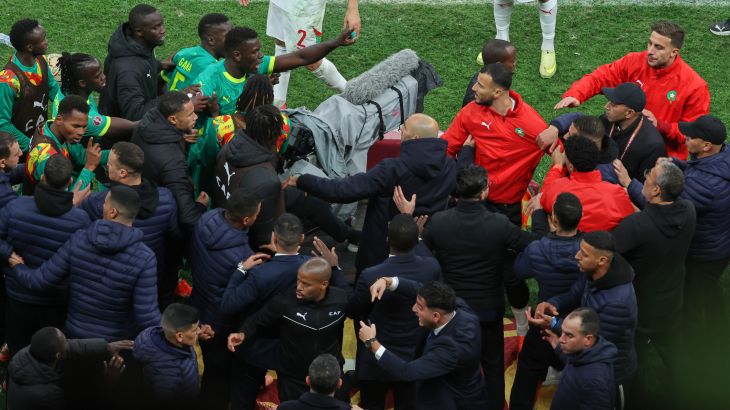
Trouble started brewing as a tight final, locked at 0-0, entered added time. Senegal’s Ismaila Sarr appeared to have scored, only for the goal to be disallowed by referee Jean-Jacques Ndala, who decided Abdoulaye Seck had fouled Morocco defender Achraf Hakimi. It was a decision that clearly incensed Senegal coach Pape Thiaw.
Then came the chaos. In the final minute of added time, Morocco’s Real Madrid star Brahim Diaz hit the ground and vehemently appealed for a penalty. After a video assistant referee (VAR) review, where Ndala was jostled by scuffling coaches and players, a highly controversial penalty was awarded, and a chance for Morocco to win it at the death.
It was then that the sparks of conflict turned into a fire. Thiaw felt Senegal had been cheated and had a case, but when he ushered his team off the field and down the tunnel in protest, he pivoted the final into dangerous territory. It took over 17 minutes for play to restart while objects were thrown from the crowd and some fans staged a pitch invasion. Thiaw later admitted he shouldn’t have taken this action, but the damage was done.
Advertisement
Diaz’s ‘Panenka’ mistake costs the host nation
The tension inside the Prince Moulay Abdellah Stadium could have led to even uglier scenes before attention turned to the penalty spot, and the ball in the hands of Diaz, while Senegal’s players continued to complain bitterly. It was his moment, Morocco’s moment, after a painful 50-year wait to be champions of Africa.
What Diaz – who was the media darling of AFCON 2025 with a tournament-high five goals – did next encapsulated the craziness of the night.
Inexplicably, he attempted a “Panenka” chip, but embarrassingly, the Real Madrid winger clipped the ball straight into the arms of Senegal’s goalkeeper Edouard Mendy. The home crowd of over 66,000 at the stadium were struggling to comprehend what had just unfolded.
And when extra time started, there was another shock for the Moroccan fans, as Pape Gueye scored a brilliant winning goal for Senegal, one which would have been the memorable moment if the final hadn’t already descended into total disorder.
Senegal became champions of Africa for the second time. In football terms, they deserved it. But the inquests into the final will mean the celebrations will be overshadowed by recriminations.

Disciplinary measures likely to follow
FIFA president Gianni Infantino, who was in attendance at the final, took to Instagram to condemn the “ugly scenes”.
Infantino called it “unacceptable to leave the field of play in this manner,” and said that “violence cannot be tolerated in our sport,” adding, “the decisions taken by the match officials must always be respected”.
The final is likely to bring severe disciplinary measures from the tournament’s governing body, the Confederation of African Football (CAF), which has seen its big showpiece marred.
Moroccan coach Walid Regragui called the scenes “shameful” and added that they “do not honour Africa”.
Strong measures are likely to be taken against Thiaw, whose media briefing had to be cancelled due to further unrest in the press room. But he’s not the only one who will face scrutiny.
Before the final, the Senegalese Football Federation (FSF) had voiced concerns over the security at the tournament, and said its players and staff were “at risk”. The FSF also raised concerns over the training pitch, hotel and ticket allocation for the final.
The officiating in the final drew plenty of criticism. While Congolese referee Ndala held his nerve under intense pressure when the Senegal players walked off, there is no escaping that his decision-making in stoppage time was puzzling. Did Seck really foul Hakimi? It felt a harsh call on the Senegal player. And why did the referee not consult VAR?
Advertisement
Did Morocco’s Diaz then go down too easily from innocuous-looking pressure by Senegal’s El Hadji Malick Diouf? Well, Ndala was initially disinterested, then appeared to cave in to the pressure from a pleading Diaz and the crowd. One such decision in favour of the hosts would be tough to take. Two was inflammatory.

Claims of host nation bias
Morocco coach Regragui had felt the need to publicly reject claims of favouritism towards the host nation that have hung around this AFCON, fuelled by Cameroon having two penalties rejected in Morocco’s quarterfinal victory.
The conspiracy theories distracted from praise Morocco otherwise received as the host nation of the tournament, with Egypt and Liverpool superstar Mohamed Salah thanking organisers and saying: “I have never participated in a competition in Africa with such a high level of organisation.”
This would have been the last thing on the mind of the tearful Moroccan fans leaving the stadium on Sunday night, and those who had gathered across the country ready to celebrate. None of this was their fault, and it was easy to feel sorry for them. The rain captured the moment. Hopes and dreams were doused. The wait to be champions would go on.
Right up until the carnage late in the final, it felt as though the prevailing narrative of AFCON 2025 would be about the improved standard of African football, and whether top-tier African teams, not least Senegal and Morocco, can go deep at the FIFA World Cup in June. Maybe even create history.
After reaching the semifinals in Qatar, and with years of youth football investment still bearing fruit, underestimating Morocco’s potential to defeat the biggest football nations would be careless. The same applies to Senegal, whose players also light up European leagues while coming together as a formidable force when representing the Lions of Teranga.
But in Rabat, the carelessness came from coaches, players and fans who dragged the ascending reputation of African football into the mud. Infantino has already made it clear that such scenes will not be tolerated in Africa or elsewhere.
The only man to have enhanced his reputation from the final fiasco is Senegal star Sadio Mane, who appeared reluctant to leave the pitch and seemingly urged his teammates to return. He also tried to calm the fury of Senegalese fans after the two controversial decisions.
Football fans everywhere should be celebrating the success of Senegal and the quality on display from both finalists. Instead, we’ll remember the dishonourable scenes in a country that co-hosts the World Cup in four years.
It’s over to CAF, and its disciplinary arm, to have the final word on AFCON 2025. With its reputation severely damaged and the need to please FIFA, don’t be surprised if there is more drama to come.
