Lebanon army says phase one of disarming non-state groups in south complete
Statement says army established state monopoly on arms in an ‘effective and tangible way’, without mentioning Hezbollah.


Published On 8 Jan 20268 Jan 2026
Save
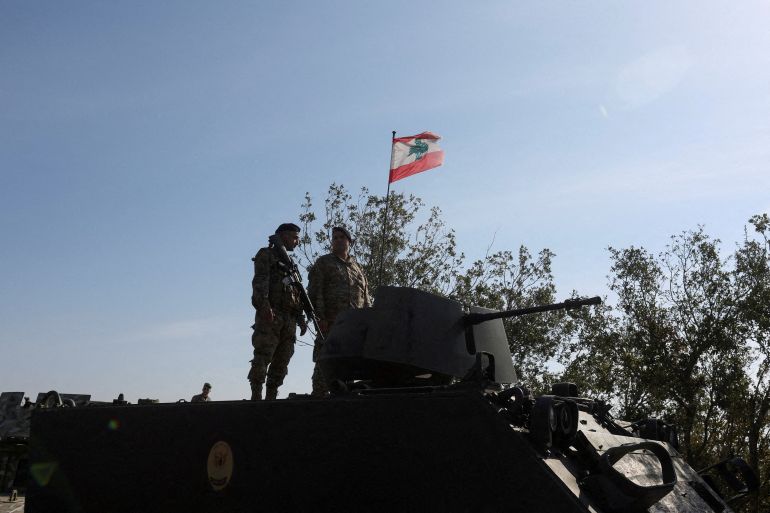
The Lebanese army has announced the completion of the first phase of its plan to bring all non-state weaponry in the south of the country under its control, covering the area between the Litani river and the Israeli border.
In a statement on Thursday, the army said it had established a state monopoly on arms in the south in an “effective and tangible way”, without specifically mentioning Hezbollah.
Recommended Stories
list of 3 itemsend of list
The military now controls the area south of the Litani river, located about 30km (19 miles) from the border, “with the exception of territory and positions still occupied by Israel”, the statement added.
The announcement comes amid growing pressure from the United States and Israel for Beirut to disarm Hezbollah, while Israel escalates strikes across Lebanon despite a ceasefire agreed in 2024.
The Lebanese army, which had set a self-imposed deadline of the end of 2025 to complete the first part of its multi-phase plan to disarm all non-state groups, caveated that more work was needed to clear unexploded ordnance and tunnels in the area.
A Lebanese security source told Reuters news agency that the statement signalled that no group would be able to launch attacks from southern Lebanon.
Army Commander Rodolphe Haykal is scheduled to brief the government on Thursday afternoon on the progress made.
Lebanon’s cabinet is expected to discuss moving to phase two of the plan, which would entail disarming non-state armed groups from a 40km (25 miles) stretch running north of the Litani to the Awali river.
Advertisement
Israeli Foreign Minister Gideon Saar praised the Lebanese government and army’s efforts on Sunday but added that they were “far from sufficient”.
Israel, which has killed more than 300 people in Lebanon since the November 2024 ceasefire, including at least 127 civilians, had previously said that Hezbollah is rebuilding its military capabilities “faster than the army is dismantling [them]”.
The United Nations peacekeeping force in southern Lebanon has said there is “no evidence” that Hezbollah’s infrastructure has been rebuilt.
Reporting from Beirut, Al Jazeera’s Zeina Khodr said: “Israel is threatening to expand … daily strikes if the disarmament does not happen, if the Lebanese government does not rein in Hezbollah.”
10,000 ceasefire violations by Israel
The US-brokered ceasefire ended more than a year of fighting between Israel and Hezbollah, culminating in Israeli strikes that severely weakened the armed group. Since then, the sides have traded accusations of violations.
The deal stipulated that Israeli troops were to withdraw from southern Lebanon, but they continue to occupy five points while breaching its terms.
The UN Interim Force in Lebanon (UNIFIL) has documented more than 10,000 ceasefire violations from Israel – 7,500 in the country’s airspace and 2,500 on the ground.
Under the deal, Hezbollah was to remove its fighters and weapons from south of the Litani river. The group has repeatedly rejected calls for disarmament, saying that Israel has not abided by its side of the deal.
Al Jazeera’s Khodr pointed out that Hezbollah “did not stand in their [the Lebanese army’s] way” during phase one of the disarmament plan, but that it was now “refusing to cooperate” with plans to move to phase two regarding the area north of the Litani river.
A committee comprised of representatives from the United States, France, Lebanon, Israel and the UN is tasked with monitoring the ceasefire.
Just this week, Israel conducted more attacks in southern Lebanon ahead of a meeting of the ceasefire committee.