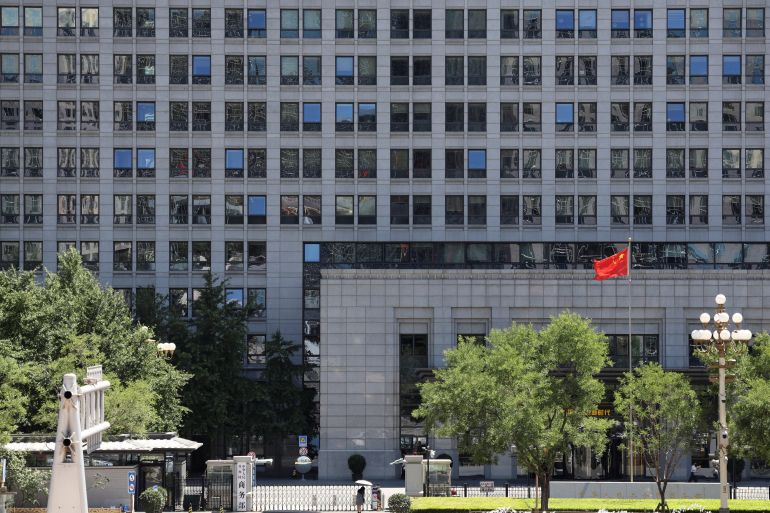
China bans export of dual-use items to Japan amid tensions over Taiwan
Japan calls for the ban’s withdrawal, calling the measures ‘absolutely unacceptable’ and ‘deeply regrettable’.

 By John PowerPublished On 7 Jan 20267 Jan 2026
Save
China has unveiled new export controls on Japan amid elevated tensions over Taiwan, prompting a rebuke by Tokyo.
China’s Ministry of Commerce said it had banned so-called dual-use items, with military applications, in light of Japan’s “erroneous” and “egregious” statements about the self-governing island, which Beijing considers its territory.
Recommended Stories
list of 4 itemsend of list
In a statement on Tuesday, the Commerce Ministry said the ban was intended to “safeguard national security” and would apply to all items that could “enhance Japan’s military capabilities”.
The notice did not specify which goods would be banned.
Japan’s Ministry of Foreign Affairs said in a statement that it had issued a protest with China and demanded the withdrawal of the measures.
Masaaki Kanai, the secretary-general of Japan’s Asian and Oceanian Affairs Bureau, told the Chinese Embassy’s deputy chief of mission, Shi Yong, that the ban was “absolutely unacceptable”, deeply regrettable”, and did not comply with international practice, according to the Japanese Foreign Ministry.
China and Japan have long been at odds over historical and territorial issues, but relations deteriorated sharply after Japanese Prime Minister Sanae Takaichi suggested late last year that Tokyo could intervene militarily if China attacked Taiwan.
In remarks to parliament in November, Takaichi said that a Chinese attack on Taiwan would be a “survival-threatening situation” for Japan, meeting the threshold to exercise the right of collective self-defence under the country’s war-renouncing constitution.
Advertisement
The Japanese leader’s remarks infuriated Beijing, which has long pledged to unify Taiwan with the Chinese mainland, using force if necessary.
In his annual New Year’s address, Chinese President Xi Jinping called the “reunification” of China and Taiwan “unstoppable”.
Xi made the remarks days after China’s military wrapped up live-fire drills that simulated a blockade of the island.
Taiwan’s governing Democratic Progressive Party considers the island a de facto independent country, though it has not formally declared independence.
Taiwan elects its leaders and has its own military, passport and currency, but is not officially recognised by the vast majority of countries, including Japan.
China insists that countries do not recognise Taipei if they wish to maintain diplomatic ties with Beijing.