UN says Sudan’s el-Fasher a ‘crime scene’ in first access since RSF capture
International aid workers discover largely deserted war-ravaged Sudanese city with few signs of life following mass atrocities.


By Faisal Ali and News Agencies
Published On 30 Dec 202530 Dec 2025
Save
A United Nations team has described Sudan’s el-Fasher as a “crime scene” after gaining access to the largely deserted city for the first time since its takeover, marked by mass atrocities, by the paramilitary Rapid Support Forces (RSF) in October.
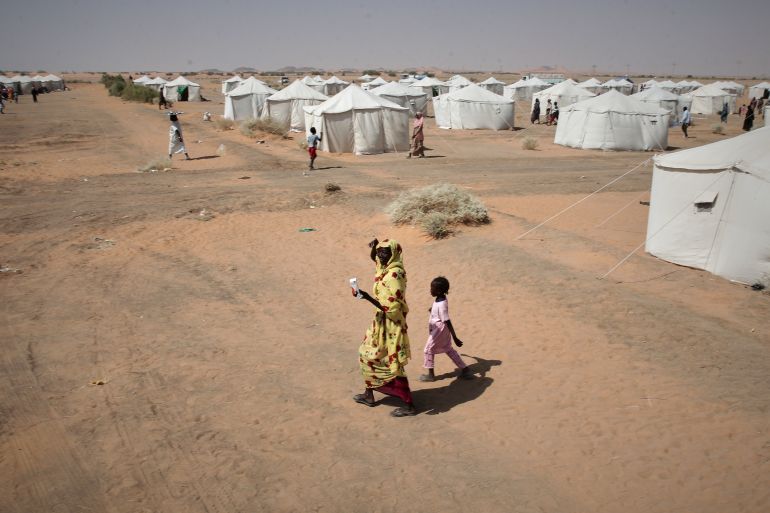
International aid staff visited el-Fasher on Friday following weeks of negotiations, finding few people remaining in what was once a densely populated city with a large displaced population.
Recommended Stories
list of 3 itemsend of list
More than 100,000 residents fled for their lives after the RSF seized control on October 26 following an 18-month siege, with survivors reporting ethnically motivated mass killings and widespread detentions.
Denise Brown, the UN resident and humanitarian coordinator for Sudan, said the UN staff members who visited the city said there “were very few people” they were able to see during the hours-long visit. Those who remained were sheltering in empty buildings or under basic plastic sheets, with a small market functioning but offering only locally grown vegetables.
“We have photos of people, and you can see clearly on their faces the accumulation of fatigue, of stress, of anxiety, of loss,” Brown told Reuters news agency on Monday.
The UN children’s agency, UNICEF, warned on Monday of an “unprecedented level” of child malnutrition in North Darfur, with 53 percent of 500 children screened in Um Baru locality this month acutely malnourished.
One in six were suffering from severe acute malnutrition, a life-threatening condition that can kill within weeks if untreated.
A report released by Yale University’s Humanitarian Research Lab in December documented the RSF’s systematic campaign to erase evidence of mass killings through burial, burning and removal of human remains.
Advertisement
Satellite imagery showed that by late November, 72 percent of clusters containing objects consistent with human remains had become smaller, while 38 percent were no longer visible at all.
The Sudan Doctors Network reported that more than 200 people, including children and women, were killed on ethnic grounds by the RSF in the Ambro, Serba and Abu Qumra areas during a recent offensive in the Dar Zaghawa region near the Chad border.
The attacks, which began on December 24, could close the last escape route for civilians fleeing to Chad.
In April, the RSF killed more than 1,000 civilians during a three-day assault on the Zamzam displacement camp, according to a UN Human Rights Office report that detailed patterns of sexual violence, including rape, gang rape and sexual slavery.
The visit to el-Fasher came as UN Secretary-General Antonio Guterres renewed calls for an immediate ceasefire on Friday in what the organisation describes as the world’s worst humanitarian crisis.
An estimated 30.4 million Sudanese now need humanitarian assistance, while the UN has been forced to halve its 2026 appeal following funding cuts from key donors.
El-Fasher was the government-aligned Sudanese Armed Forces’ (SAF) last major stronghold in Darfur before falling to the RSF, which grew out of the government-backed militia Popular Defence Forces, also known as the Janjaweed, accused of genocide against non-Arab ethnic groups during the 2000s Darfur conflict.
The city’s capture allowed the RSF to consolidate control over the Darfur region, and fighting has since expanded into the Kordofan region, effectively splitting the country down the middle.
An estimated 107,000 people have been displaced from el-Fasher and surrounding areas since late October, with 72 percent remaining within North Darfur state, according to the UN.
Roughly three-quarters of those displaced were already internally displaced people (IDPs) who had fled previous violence, forcing some households to move three or more times. In total, 1.17 million people originally from el-Fasher have been displaced, representing 13 percent of all IDPs.
The war, which erupted in April 2023 when a power struggle broke out between the SAF and the RSF, has killed more than 100,000 people and displaced 14 million, including 4.3 million who have fled to neighbouring countries.
Army leader General Abdel Fattah al-Burhan recently rejected negotiations, insisting the war would end only with the RSF’s “surrender” and withdrawal from areas it occupied after the Jeddah-brokered agreement in May 2023.
Advertisement
The United States Department of State expressed deep concern over “rhetoric from Sudanese Armed Forces leadership calling for military solutions” and urged Sudan’s military leaders to pursue “a path towards peace, not continued conflict”.
The RSF earlier dismissed a peace proposal from Sudanese Prime Minister Kamil Idris, calling on its withdrawal as “wishful thinking”.
Brown said Friday’s visit aimed to assess whether el-Fasher could be accessed safely for basic supplies, but added: “We’re still very concerned about those who are injured, who we didn’t see, those who may be detained.”