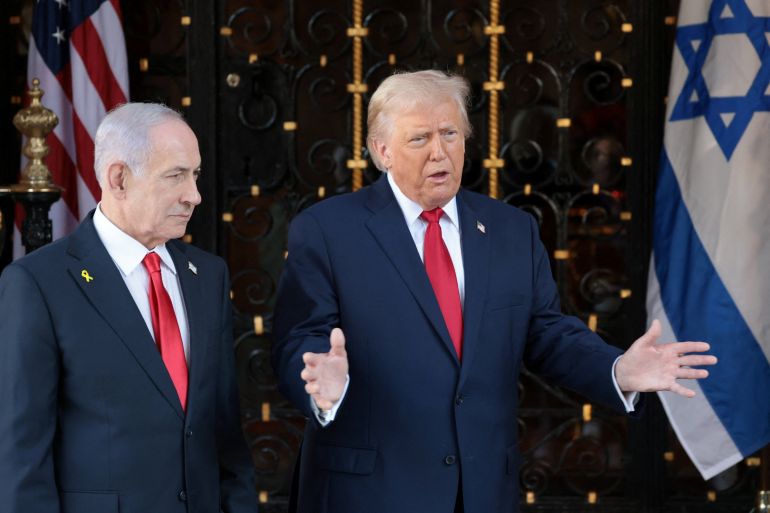
Trump says US would back strikes against Iran’s missile programme
Speaking alongside Benjamin Netanyahu, Trump threatens to ‘knock’ down Iran’s attempts to rebuild its nuclear capabilities.


Published On 29 Dec 202529 Dec 2025
Save
United States President Donald Trump has suggested that Washington would consider further military action against Iran if Tehran rebuilds its nuclear programme or missile capacity.
Speaking from Florida on Monday, Trump refused to rule out a follow-up attack after US air strikes in June damaged three Iranian nuclear facilities.
Recommended Stories
list of 3 itemsend of list
“Now I hear that Iran is trying to build up again, and if they are, we’re going to have to knock them down,” Trump told reporters. “We’ll knock them down. We’ll knock the hell out of them. But hopefully that’s not happening.”
Trump issued his threat as he welcomed Israeli Prime Minister Benjamin Netanyahu to his Mar-a-Lago estate in Palm Beach, Florida.
Trump said the US and Israel have been “extremely victorious” against their enemies, referring to the wars in Gaza and Lebanon as well as June’s strikes against Iran.
When asked whether the US would back an Israeli attack targeting Iran’s missile programme, Trump said, “If they will continue with the missiles, yes. The nuclear? Fast. OK? One will be: Yes, absolutely. The other is: We’ll do it immediately.”
Another round of strikes against Iran would likely stir opposition in the US, including from segments of Trump’s own base of support.
Trump has repeatedly said the June strikes “obliterated” Iran’s nuclear programme, and he has raised the spectre of the country acquiring a nuclear weapon.
But Iran has denied any such ambitions and said its nuclear programme is solely for the purposes of generating energy for civilian use.
Advertisement
Still, in Monday’s remarks, Trump discussed Iran’s nuclear capabilities in the same breath as its military ones.
Analysts point out that Israeli officials and their US allies have recently been drumming up concern about Iran’s missiles.
During the conflict in June, sometimes referred to as the 12-day war, Tehran fired hundreds of missiles in response to an Israeli attack that killed the country’s top generals, several nuclear scientists and hundreds of civilians.
US Senator Lindsey Graham, an Iran hawk who is close to Trump, visited Israel this month and repeated the Netanyahu government’s talking points about the dangers of Iran’s long-range missiles. He warned that Iran is producing them “in very high numbers”.
“We cannot allow Iran to produce ballistic missiles because they could overwhelm the Iron Dome,” he told The Jerusalem Post, referring to Israel’s air defence system. “It’s a major threat.”
Iran has ruled out negotiating over its missile programme, which is at the core of its defence strategy.
On Monday, Trump said Iran should “make a deal” with the US.
“If they want to make a deal, that’s much smarter,” Trump said. “You know, they could have made a deal the last time before we went through a big attack on them, and they decided not to make the deal. They wish they made that deal.”
Monday’s sabre-rattling comes weeks after the Trump administration released a national security strategy that called for the US to shift its foreign policy resources away from the Middle East and instead focus on the Western Hemisphere.
But advocates of the strategy warn that another episode of attacking Iran may escalate into a longer, broader war.
In June, Iran responded to the US strikes with a missile attack against a US base in Qatar, which did not result in any US casualties. Trump announced a ceasefire to end the war shortly after the Iranian response.
Trita Parsi, the executive vice president at the Quincy Institute, a US think tank that promotes diplomacy, told Al Jazeera last week that the Iranian response would be “much harsher” if the country is attacked again.
“The Iranians understand that unless they strike back hard and dispel the view that Iran is a country that you can bomb every six months – unless they do that – Iran will become a country that Israel will bomb every six months,” Parsi said.