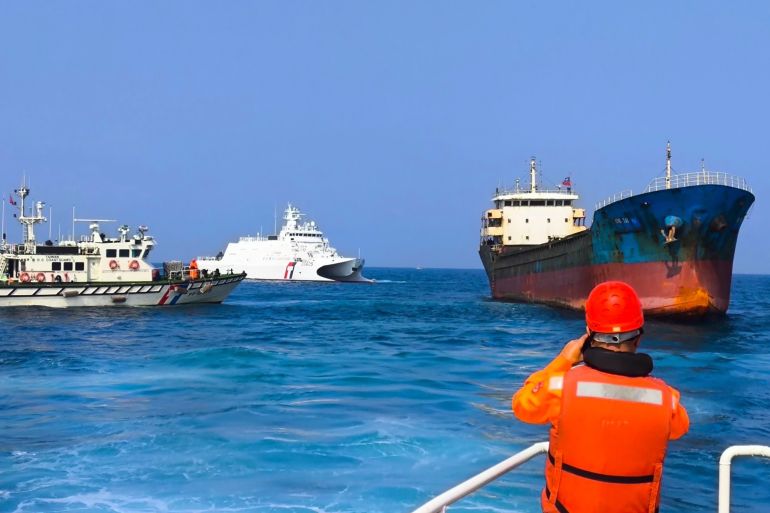
China probe finds Taiwanese men controlled ship that cut undersea cables
Chinese officials claim Taiwanese smugglers are to blame for February incident Taipei says was an act of hybrid warfare.

By News Agencies
Published On 24 Dec 202524 Dec 2025
Save
China has accused two Taiwanese nationals of leading a smuggling operation involving a Chinese-crewed vessel that damaged subsea cables in February, in an incident that has stoked tensions between the countries.
The public security bureau in Weihai, in China’s eastern Shandong province, said on Wednesday that a probe into the incident showed that two Taiwanese men had been operating the ship involved – the Togo-registered Hong Tai 58 – as part of a longstanding operation smuggling frozen goods into China.
Recommended Stories
list of 3 itemsend of list
In comments carried in Chinese state media, China’s Taiwan Affairs Office accused Taiwan’s governing Democratic Progressive Party of falsely claiming that Beijing had used the Hong Tai 58 to deliberately sabotage an undersea cable off the island in a bid “to stir cross-Strait confrontation”.
Taiwan has accused Beijing of severing the cable as a so-called “grey zone” or “hybrid warfare” tactic to apply pressure on the self-ruled island of 23 million people, which China views as its territory.
The terms refer to low-grade coercive acts such as sabotage that hold a certain degree of plausible deniability.
But China has denied its involvement, calling the incident a “common” maritime occurrence that has been “exaggerated” by Taiwanese authorities.
In June, a Taiwanese court sentenced the Chinese captain of the Hong Tai 58 to three years in jail after finding him guilty of intentionally damaging the cables off Taiwan.
Seven Chinese crew members were sent back to China without charge, and were interviewed by authorities on the mainland as part of their probe into the incident.
Advertisement
Reward offered
Announcing the probe’s findings, the Weihai public security bureau offered a reward of up to 250,000 yuan ($35,569) for information or assistance regarding the Taiwanese suspects, who it said had the surnames Chien and Chen.
The pair had been on a Chinese customs office wanted list since 2014, it added.
Taiwan’s Mainland Affairs Council said the Chinese Communist Party does not have jurisdiction over Taiwan and urged the Chinese authorities to provide concrete evidence if they had it.
“In the absence of concrete evidence, publicly announcing names and offering rewards is not a civilized practice,” it said in a statement. “It is merely another instance of cross-border repression and political manipulation.”
Subsea cables are the backbone of the internet and global telecoms industry, carrying nearly all of the world’s internet traffic, but are also susceptible to breakdowns from movements on the sea floor or human activity.
Between 100 and 200 cable breakdowns occur each year, according to industry data, and proving damage as deliberate is difficult.
Since 2023, there have been at least 11 cases of subsea cable breakdowns around Taiwan, although some were later ruled as accidents or due to the old age of the equipment.
Countries around the Baltic Sea have also seen an increase in undersea cable breakdowns since the Russian invasion of Ukraine, and they have struggled to bring legal cases against China and Russia-linked ships and their owners.