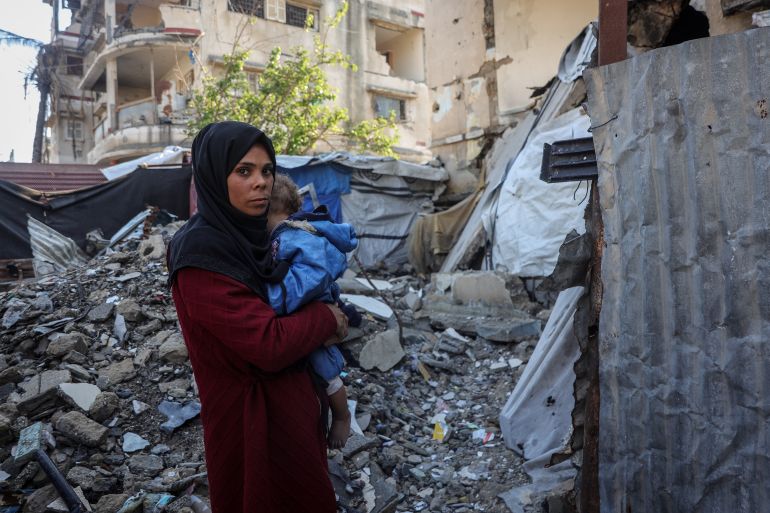
Tragedy in Gaza as winter storm turns family’s shelter into rubble
A devastating roof collapse in Gaza leaves one dead, six injured, and a family struggling for survival amid the winter.


By Maram Humaid
Published On 19 Dec 202519 Dec 2025
Save
Gaza City – The rain came pouring down on Osama al-Hussari’s home, the storm that hit Gaza City earlier this week refusing to relent.
Inside the 57-year-old’s home in the Shati refugee camp were not just his wife Rawiya and their 10 children, but also extended family members, including his brother’s children – making up 25 people in total.
Recommended Stories
list of 3 itemsend of list
The home had survived two years of Israeli bombing, but was heavily damaged. Rainwater was leaking in from the roof, flooding the inside, and forcing Osama to attempt to fix the problem on Tuesday.
“I called a neighbour and friend who works in construction to help inspect the problem and seal the openings where water was coming in from,” Osama told Al Jazeera.
But as they clambered onto the roof, disaster struck. The neighbour, Mohammed al-Helou, also 57, was inspecting one corner using a hammer.
The roof then collapsed.
Mohammed was left trapped under the rubble for two hours, unreachable. His body was recovered by civil defence teams two hours later.
Six others, including two children, were injured, some left with broken legs.
“It was absolutely terrifying, like a torrent of dust and stones exploding in my face,” Osama says, wiping away tears.
“We survived by a miracle, but my dear neighbour and friend lost his life without warning, and his family lost him in an instant.”

The collapse
A house is a rare thing in Gaza, with most buildings in the Palestinian enclave destroyed by Israel during its two-year genocidal war.
Advertisement
It is what made Osama cling to his home, despite its condition, rather than live in a tent as so many thousands of other Palestinians do in Gaza. It’s also why so many of his family members had gathered to live with him after the October ceasefire, after being displaced across the Gaza Strip.
“When we arrived at my house, we breathed a sigh of relief that it was still standing,” Osama says. “But it was in bad shape and clearly heavily affected, especially since more than three explosive robots had been detonated in the area.”
He points to twisted metal pieces nearby, saying that they are remnants of those explosions.
Explosive robot weapons were widely used by the Israeli army during the most recent ground invasion of northern Gaza in mid-September.
“The entire area is destroyed, and all the buildings around us were bombed with the most powerful weapons. Our house was badly affected as well,” Osama says.
With no alternatives available, the family chose to remain inside the cracked walls, believing it better than living in tents, where people are currently dying from the cold.
“We used to say a concrete roof is better than a tent. We can’t even afford tents or their supplies. But we never imagined it would collapse on our heads and nearly kill us all.”

Nowhere to go
Rawiya al-Hussari, 41, Osama’s wife, described the terrifying moment the building collapsed.
She immediately fled with her five children, while everyone around her was screaming, only to be told that her middle son, Mohammed, was still trapped under the rubble.
“I ran out, then they told me, ‘Your son Mohammed is under the rubble with his uncle.’ I completely lost my mind and ran back towards him,” she says, holding back tears as she hugs her 12-year-old son, who would survive.
“I started screaming hysterically, calling out, ‘Mohammed, Mohammed, can you hear me?’ He answered in a muffled voice, saying, ‘I’m here, save me. I’m OK.’ I removed the stones with the help of some men and relatives who rushed to help. But the man next to him didn’t respond; it seemed he had died instantly.”
Rawiya and the other mothers with her trembled as they recounted their escape from the house before it collapsed entirely, leaving them unable to take any belongings or clothes.
“We don’t know how we are supposed to die, by bombing or by buildings collapsing over our heads,” Rawiya says, pointing to the ruins. “Look at it; it’s as if one or two missiles hit it.”
Advertisement
With the collapse of the al-Hussari home, the number of houses that have collapsed in Gaza since the start of winter is 17, with officials warning the number is likely to increase.
In response to the growing danger, emergency teams in Gaza have activated a committee to inspect buildings at risk of collapse and evacuate residents before the next storm arrives.
As the al-Hussari family struggles to absorb the shock, they now find themselves homeless overnight, with no alternative shelter.
“We slept here in the street last night, 12 children and women,” Osama says angrily. “We all slept outside with no tents, no tarps. This is our end: either we die under crumbling walls, or we freeze to death in the street.”
“I wish we had all died inside the house and been spared this life.”
