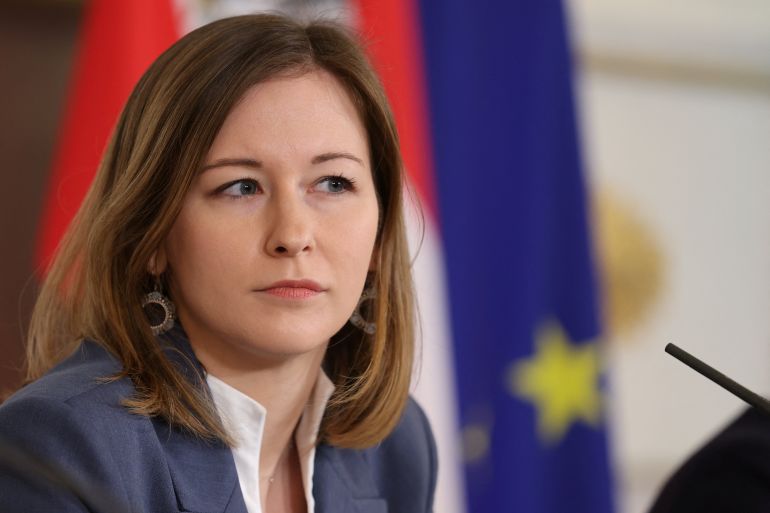
Austrian lawmakers pass headscarf ban for under-14s in schools
Rights group Amnesty says ban, which will affect around 12,000 girls, will ‘add to racist climate towards Muslims’.

By News Agencies
Published On 11 Dec 202511 Dec 2025
Save
Austria’s lower house of parliament has passed a ban on Muslim headscarves in schools after a previous ban was overturned on the grounds that it was discriminatory.
Lawmakers passed the new legislation on Thursday by a large majority, meaning that girls younger than 14 will not be permitted to wear headscarves that “cover the head in accordance with Islamic traditions” in all schools, with non-compliance fines ranging from 150 to 800 euros ($175-930).
Recommended Stories
list of 2 itemsend of list
In 2019, the country introduced a ban on headscarves for under-10s in primary schools, but the Constitutional Court struck it down the following year, ruling that it was illegal because it discriminated against Muslims, going against the state’s duty to be religiously neutral.
The Austrian government says it has “done [its] best” to see that this law will hold up in the courts.
The new law, which was proposed by the governing coalition of three centrist parties at a time of rising anti-immigration and Islamophobic sentiment, was also backed by the far-right Freedom Party, which wanted it to go even further so it would apply to all students and staff. The Greens were the only party to oppose it.
Integration Minister Claudia Plakolm, of the conservative People’s Party, which leads the governing coalition, called headscarves for minors “a symbol of oppression”.
Yannick Shetty, the parliamentary leader of the liberal Neos, the most junior party in the governing coalition, told the lower house that the headscarf “sexualises” girls, saying it served “to shield girls from the male gaze”.
Advertisement
Rights groups have criticised the plan. Amnesty International said it would “add to the current racist climate towards Muslims”.
IGGOe, the body officially recognised as representing the country’s Muslim communities, said the ban “jeopardises social cohesion”, saying that “instead of empowering children, they are stigmatised and marginalised”.
Angelika Atzinger, managing director of the Amazone women’s rights association, said a headscarf ban would send girls “the message that decisions are being made about their bodies and that this is legitimate”.
Education Minister Christoph Wiederkehr of the Neos said young girls were coming under increasing pressure from their families, and also from unrelated young boys, who tell them what to wear for “religious reasons”.
The Greens’ deputy parliamentary leader, Sigrid Maurer, agreed that this was a problem, and suggested interdisciplinary teams, including representatives of the Muslim community, be set up to intervene in schools when “cultural tensions” flare.
Under the ban, which comes into effect in February, an initial period would be launched during which the new rules would be explained to educators, parents and children with no penalties for breaking them.
After this phase, parents will face fines for repeated non-compliance.
The government said that about 12,000 girls would be affected by the new law.