Trump’s $12bn aid package: Are tariffs bleeding US farmers?
Trump says funds will be made available from tariffs’ revenues and promises trade policies will make US farmers ‘strong’.


Published On 10 Dec 202510 Dec 2025
Save
US President Donald Trump has announced a $12bn aid package for farmers, offering financial assistance to a core part of his political base that has been hit hard by falling crop prices and the impact of his trade policies.
Unveiling the plan at the White House in Washington, DC alongside Agriculture Secretary Brooke Rollins and several farmers on Monday, Trump said: “Maximising domestic farm production is a big part of how we will make America affordable again and bring down grocery prices.”
Recommended Stories
list of 4 itemsend of list
Rollins said the Farmer Bridge Assistance programme’s initial phase would provide $11bn for row crop farmers – those who cultivate crops such as corn, soya beans and cotton in rows. An additional $1bn has been earmarked for farmers who grow some speciality crops not covered by this. The aid money is expected to be made available by the end of February.
The package is Trump’s latest effort to defend his economic record and respond to public anxiety about rising food costs. It also comes after China curbed its purchases of US soya beans in retaliation for steep US trade tariffs, which have also caused the cost of fertiliser and other agricultural products to soar.
How will this aid be distributed to farmers?
The US Department of Agriculture (USDA) will calculate per-acre payments for different crops using a formula that estimates production costs. Payments will be capped at $155,000 per farm or individual, and only farms earning less than $900,000 annually will qualify.
The USDA’s formula is designed to bolster small-scale producers who may be struggling more than others. “We looked at how they were hurt, to what extent they were hurt,” Trump said.
Advertisement
Farmers will begin receiving funds on February 28, according to Rollins. Meanwhile, applications for funds will open in the coming weeks so that farmers “will know exactly what that number looks like”.
Trump said the money for the scheme will come from tariff revenues.
Though Trump has, at times, downplayed cost-of-living issues, he visited Pennsylvania on Tuesday to explain to voters how his administration is addressing this concern.
At the same time, he defended his record on trade and the sweeping reciprocal tariffs he has imposed on countries around the world this year. “It’s amazing,” Trump said of tariffs at a rally in Mount Pocono, Pennsylvania. “It’s the smart people who understand it. Other people are starting to learn, but the smart people really understand it.”
Why is this aid package being introduced now?
Many farmers continue to support Trump. The country’s most farming-dependent counties overwhelmingly backed him in last year’s presidential election by an average of 77.7 percent, according to the USDA.
Experts say his anti-establishment rhetoric has resonated with rural communities that feel overlooked by political elites in Washington, DC. His promises of deregulation also appealed to many farmers who feel frustrated by federal rules they view as burdensome.
But the president’s trade agenda and the imposition of trade tariffs to address the country’s trading deficit with many other countries have hit farmers hard. Trump’s “liberation day” tariff announcement earlier this year provoked steep retaliatory duties on US products, particularly from China, including on US agricultural exports.
Trump’s latest package is an echo of a $12bn programme he offered to farmers in 2018 during his first-term administration’s initial trade dispute with China.
Which crops have been hardest hit by trade tariffs?
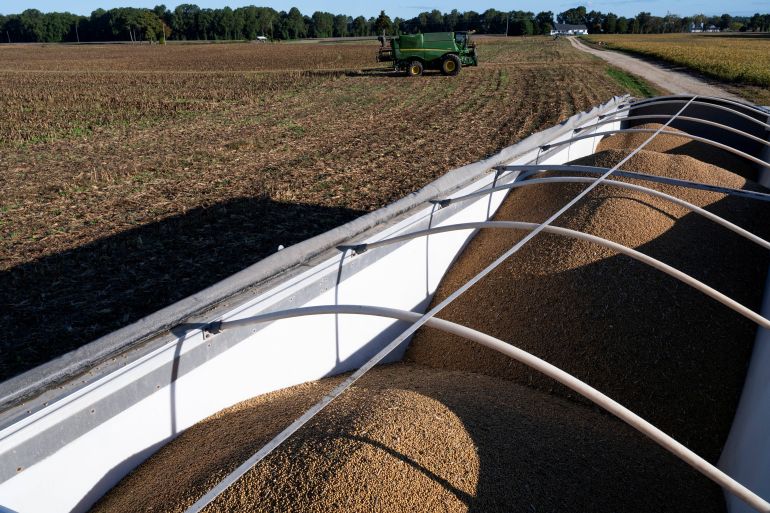
Soya bean farmers have been badly bruised by the US-China trade spat this year. Trump was the principal architect of recent tensions – his sweeping “reciprocal” tariffs, launched earlier this year, targeted China more than any other country.
Historically, more than half of all soya beans produced in the US – mainly in the Midwest – have been sold to China. But after Trump imposed steep tariffs on Chinese goods, Beijing raised duties on US soya beans to 34 percent.
Last year, China bought slightly more than 50 percent (27 million metric tons) of the $24.5bn of produce that US soya bean farmers sold to international markets. This year, US exports to China have so far fallen by more than half.
Advertisement
Instead, China has begun buying more soya beans from Brazil and other South American nations.
The American Soybean Association has also warned that tariffs are driving up costs for soya bean producers. In particular, US tariffs on Moroccan fertiliser, which have been hiked from 2.1 percent to 16.8 percent, have squeezed farmers.
In October, following a meeting with Chinese President Xi Jinping in South Korea, Trump said Beijing had committed to buying 12 million metric tons of US soya beans by the end of this year, and 25 million metric tons annually for the next three years.
Trump is also facing pressure to address rising beef prices. On November 7, he asked the Department of Justice to investigate foreign-owned meatpackers in the US, which he claims are driving up costs, though he has provided no supporting evidence for this.
Then, on November 20, Trump announced he would peel back trade tariffs of up to 50 percent on certain Brazilian agricultural products, including coffee and beef. The reversal was broadly interpreted as an acknowledgement that the tariffs were fuelling inflationary pressures at home.
More broadly, US consumer sentiment remains near record lows. In November, data released by the University of Michigan showed that Americans view their personal finances as the weakest they’ve been since 2009. High inflation is the primary cause of concern.

Prices of other food staples have also risen recently. Compared to last year’s Thanksgiving Day, potatoes this year on the November US holiday were up by 3.7 percent, bread rolls 3.9 percent and apples 5.3 percent – all outpacing the 3 percent annual inflation rate, government data shows.
Will Trump’s bailout package be enough to rescue farmers?
While farmers have generally welcomed Trump’s bailout package, many view it as a temporary reprieve rather than a solution to long-term challenges like rising costs and the decline of small-scale farming.
“[It’s] a start, but I think we need to be looking for some avenues to find other funding opportunities, and we need to get our markets going. That’s where we want to be able to make a living from,” Kentucky farmer Caleb Ragland told the Associated Press on Monday.
Family farmers and those renting land have been particularly exposed to Trump’s trade war. Many smaller farms, already operating on thin margins, have struggled to absorb the shock of higher input costs.
As strains persist, analysts have warned that the sector may undergo further consolidation, with large industrial farms expanding their reach while smaller growers disappear or take on more debt just to stay afloat.
Earlier this year, Cornell University in Ithaca, New York, estimated that in the first half of this year, the number of farm bankruptcies was 60 percent higher than a year before. In addition, farm sector debt is expected to rise by 5 percent to nearly $600bn in 2025.
Libby Schneider, deputy executive director of the Democratic National Committee, said Trump’s aid package does not go far enough: “Farmers don’t want handouts – they want their markets back,” she said in a statement.
Advertisement