Trump slaps Mexico with 5 percent tariff over violations of water treaty
Leaders on both sides of the border have faced pressure from farmers and ranchers to secure more water for their products.

 Published On 9 Dec 20259 Dec 2025
Save
United States President Donald Trump has raised tariffs by 5 percent on imports from Mexico, accusing the country of failing to uphold a cross-border water treaty.
The tariff hike was revealed in a social media message late on Monday, as tensions simmer between the two North American neighbours.
Recommended Stories
list of 3 itemsend of list
“Mexico continues to violate our comprehensive Water Treaty, and this violation is seriously hurting our BEAUTIFUL TEXAS CROPS AND LIVESTOCK,” Trump wrote on his platform, Truth Social.
“Mexico still owes the U.S over 800,000 acre-feet [986.8 million cubic metres] of water for failing to comply with our Treaty over the past five years.”
The US president’s message set a demand and a deadline. He called on Mexico to release 200,000 acre-feet of water — equivalent to 246 million cubic metres — by December 31.
But the punitive tariffs, Trump added, are set to begin right away.
“As of now, Mexico is not responding, and it is very unfair to our U.S. Farmers who deserve this much needed water,” Trump said.
“That is why I have authorized documentation to impose a 5% Tariff on Mexico if this water isn’t released, IMMEDIATELY. The longer Mexico takes to release the water, the more our Farmers are hurt.”

Drought-stricken Mexico struggles
Trump’s demands are part of a long-running dispute over the 1944 Water Treaty, which governs the output of the waterways that spider across the border region — namely the Rio Grande, the Colorado River and their tributaries.
Advertisement
Under the terms of the treaty, each year, the US must allow Mexico to receive 1.5 million acre-feet of water, or 1.85 billion cubic metres, from waterways streaming south.
In return, Mexico lets at least 350,000 acre-feet, or 431 million cubic metres, flow northward to the US.
But years of drought have left Mexico in crisis. According to a 2024 report from the North American Drought Monitor, an intergovernmental agency, more than 75 percent of Mexico is experiencing “moderate to exceptional” drought levels.
That is the highest recorded level since 2011. As a result, Mexico officials have warned they cannot meet the standards inked in the eight-decade-old treaty.
But agricultural interests in the border state of Texas are pressuring US lawmakers to act, saying the decreased water supply has withered their businesses.
Texas Governor Greg Abbott, a Republican, is among those who have pledged to champion the farmers’ cause.
“Mexico must be held accountable for their continued breaches of our long-standing water agreement,” Abbott said in a news release last month.
“Because of their pattern of neglect, Texas farmers are enduring preventable hardship and an erosion of the agricultural viability of the Rio Grande Valley.”

A water ‘debt?’
The issue has been an ongoing source of cross-border strife. In 2020, desperate farmers in Mexico went so far as to take over a dam in the border state of Chihuahua to prevent the “water payments” from flowing to the US, while their crops shrivelled.
Mexico’s deficit under the 1944 Water Treaty has continued to grow since then, leading to what the US considers a water “debt”.
The US claims it is owed hundreds of millions of cubic metres of water from the treaty’s last five-year cycle.
Monday, however, was not the first time Trump has wielded economy-buckling tariffs as a means of enforcing compliance. In April, he made a similar threat.
“We will keep escalating consequences, including TARIFFS and, maybe even SANCTIONS, until Mexico honors the Treaty, and GIVES TEXAS THE WATER THEY ARE OWED,” he wrote on Truth Social.
One month earlier, in March, the Trump administration also denied Mexico’s request for a special delivery of Colorado River water to the drought-stricken border city of Tijuana.
It was the first time since the water treaty was signed that the US had taken such an action.
“Mexico’s continued shortfalls in its water deliveries under the 1944 water-sharing treaty are decimating American agriculture — particularly farmers in the Rio Grande valley,” the US State Department said in a statement.
Advertisement
“As a result, today for the first time, the U.S. will deny Mexico’s non-treaty request for a special delivery channel for Colorado River water to be delivered to Tijuana.”
In response, the Mexican government denied violating the 1944 treaty. Instead, it said it supplied what it could in the face of extreme water shortages.
“We have experienced three years of drought, and to the extent that water has been available, Mexico has been fulfilling its obligations,” Mexican President Claudia Sheinbaum said.

A new deal, a new dilemma
Ultimately, the two countries ended the impasse on April 28, with a new deal to regulate cross-border water flow.
According to the US, the agreement required Mexico to immediately release water from international reservoirs.
It also stipulated that Mexico would boost the amount of water flowing from the Rio Grande northwards through the end of the last five-year cycle, which expired in late October.
Mexico has claimed it fulfilled those requirements. But Texas lawmakers said the country fell far short, and some want the deficit to roll over into the next five-year cycle.
Because of a 43-day-long government shutdown in the US, it is unclear how much water passed across the border during the end of that five-year period. Only preliminary data is available.
Still, the Texas Commission on Environmental Quality (TCEQ), a state agency, has petitioned the Trump administration to take action.
“Economic losses from delayed water deliveries cannot be recovered,” TCEQ Commissioner Tonya Miller said in a November statement.
Meanwhile, in Mexico, the Sheinbaum administration faced domestic pressure to loosen water restrictions on local farmers.
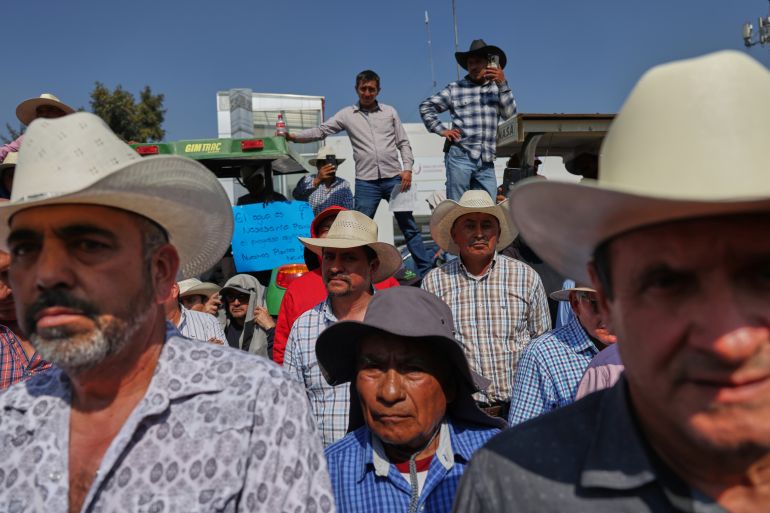
Just this month, farmers poured in from the countryside to form a blockade with their tractors in front of Mexico’s Congress, as a protest against a new bill that would tighten the tap on their water.
River flows are not the only point of tension between the two countries: Trump has pushed for a crackdown on cross-border drug trafficking and migration, while Sheinbaum has warned against US threats to Mexico’s sovereignty.
But while Sheinbaum has largely managed to keep relations steady with Trump, there are signals that their bond may be fraying.
“ Let me just put it this way,” Trump said last month. “I am not happy with Mexico.”