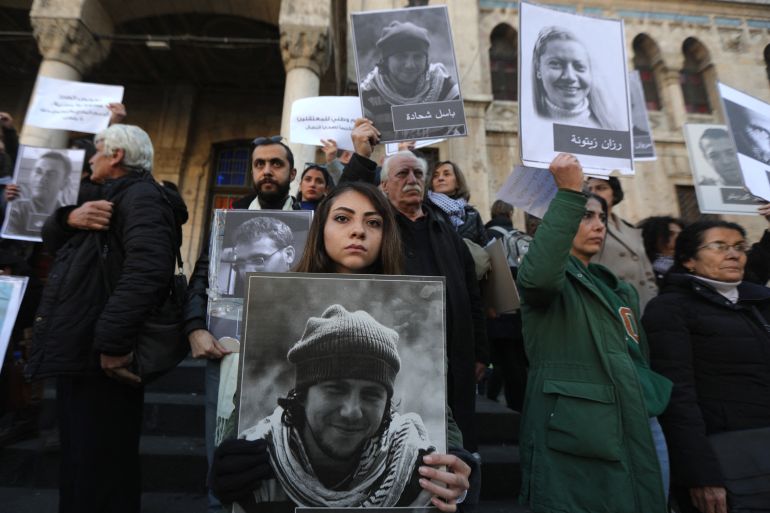
A nation still searching
A year after Bashar al-Assad’s regime fell on December 8, 2024, Syrians are still searching for the truth.
The portraits that hung from lampposts have been replaced by the faces of the missing, photocopied pictures taped to shopfronts and walls. Families have searched graveyards and abandoned prisons, hoping a scrap of fabric or a piece of paper might give them answers.

Over 13 years of war, which killed more than half a million people and displaced half the country, the regime and its allies disappeared between 120,000 and 300,000 people, according to the government’s National Commission for the Missing.
The system that disappeared them was deliberate – a web of informants, secret police, files and fear. Arrests were made without warrants, over a neighbour’s grudge, a relative’s rumour, or a bribe.
In the days after the regime’s collapse, some Syrians celebrated. Others ran to the prisons. At Sednaya Prison, people grabbed whatever documents they could, as papers were trampled into the ground and crucial evidence disappeared underfoot. Families searched for loved ones, even beneath the floors – what they found were ropes, chains, and electric cables.
Only a few families were reunited after al-Assad’s fall.
For the rest, grief and hope coexist as the whereabouts of the disappeared remain unknown.
The new government, led by President Ahmed al-Sharaa, has pledged to uncover the truth. In May 2025, decrees created the National Commission for the Missing and the National Commission for Transitional Justice. Advisory boards have been appointed, and legislation is being drafted.
But progress is slow in a nation stripped of laboratories, specialists, and funds. Officials admit they face a mammoth task: building a national database, recruiting forensic experts, establishing DNA capacity – and finding the dead before time and decay erase them.

On the ground, the work has fallen largely on those who once pulled survivors from rubble, the White Helmets, volunteers for the Syria Civil Defence (SCD).
They photograph and document, noting fragments of identity like clothing, teeth, bones. Each set of remains is boxed and sent to an identification centre. There, the process stops. The boxes of bones stay sealed. According to the White Helmets, no family has been reunited with the remains of the disappeared.
Officials and humanitarian workers say that without DNA laboratories, forensic specialists, or a functioning identification system, the bones can only be stored, even when families are sure they know who they are.
On November 5, the National Commission for the Missing signed a cooperation agreement with the International Commission on Missing Persons (ICMP), the Independent Institution on Missing Persons in Syria (IIMP), and the International Committee of the Red Cross (ICRC).
Officials say these institutions will investigate past crimes, build a national database of the missing, support families, and, eventually, identify and return remains.
The cooperation agreement was billed as the start of a comprehensive national process for truth and justice, committing all parties to share expertise and help build the backbone of an identification system.
The task is vast. There are no reliable official figures; estimates of the disappeared range from 120,000 to 300,000 people, numbers compiled from various sources without a unified database.
Before anyone can be identified, the state must gather what already exists – detention registers, civil documents, military files, and lists held by opposition groups and by survivor associations like the Caesar Families, Families for Freedom and the Sednaya Association.
Then they must collect testimonies from survivors and families, and coax information from former officials and guards who may know where people were taken or buried. All this must be uploaded into a central database that has not yet been built.
“You cannot start immediately searching, looking for answers,” says Zeina Shahla, a member of the government’s National Commission for the Missing. “You need to set up the ground.”
Right now, Syria has only a single identification centre in Damascus, set up with the ICRC, but no dedicated DNA laboratory. Offices in other cities are promised, but not yet open.
“We have huge needs – technical needs, financial needs, human resources,” Shahla says.
“Most of them are not available in Syria, especially the … scientific resources. We don’t have DNA labs. We don’t have the forensic labs. We don’t have the doctors. So we need a lot of resources.
“And of course, this fight is too complicated because it’s affecting millions of people. We need to work fast, but at the same time, we cannot work fast.”

The officials point to the scale of the wreckage. Thirteen years of war, hundreds of thousands missing, institutions hollowed out by sanctions.
Many have not even reported their missing, still afraid of what doing so might invite. Around one in five Syrians now lives abroad, scattering the reference samples needed to match the dead to the living.
Some families of the disappeared feel they are at the bottom of the state’s list of priorities. Others, like the Caesar Families Association, understand this process takes time.
Even if every promise is kept, the journey from a signed memorandum in Damascus to a named grave may take decades. Many of the families waiting across Syria may not live to see the day their children are returned to them.